Canada prompt payment

Canada Prompt Payment: What Your Contract Can't Override

Canada's prompt-payment reform started with Ontario's Construction Act in October 2019 and has spread across the country: fixed payment clocks, mandatory notices for withholding, rapid adjudication, and anti-waiver provisions that void contrary contract terms. If your subcontract still reads like 2018 — 60-day terms, silent pay-when-paid — much of it is now overridden by statute.

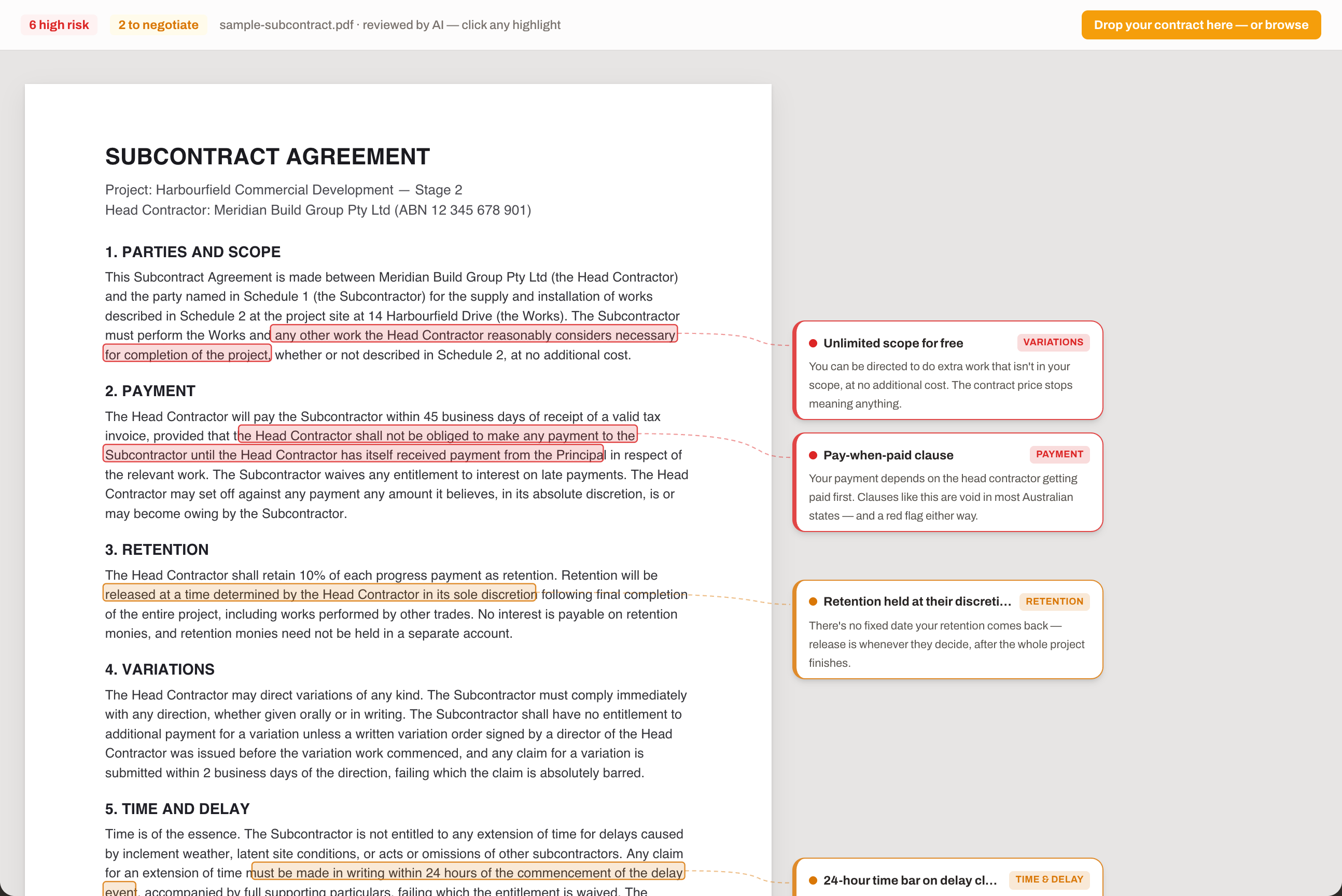
A reviewed construction subcontract in ContractorCounter Review: risky clauses highlighted on the page with margin callouts for pay-when-paid, uncapped liquidated damages, and retention terms
The AI reads your contract before you pay — see a fully reviewed sample free
  • 28-day owner / 7-day sub clocks
  • Notice-of-non-payment rules decoded
  • Anti-waiver: contracts deemed amended
  • Province-by-province status

Ontario's clocks: 28 days, then 7

The owner must pay a proper invoice within 28 days; to withhold, it must deliver a prescribed notice of non-payment within 14 days stating all reasons, and pay the undisputed balance regardless. Once the contractor is paid, every subcontractor in that invoice must be paid within 7 days. Contracting out is impossible by design: s 4 voids any agreement that the Act doesn't apply, and s 5(1) deems every contract amended to conform.

Pay-when-paid, the Canadian way

Ontario didn't ban pay-when-paid — it made it expensive to invoke. A contractor who wants to defer paying you because the owner hasn't paid must give a formal notice of non-payment attributing the shortfall, attach the owner's notice, and undertake to take the owner to adjudication within 21 days. No notice, no deferral: you must be paid within 35 days of the proper invoice even if the owner never pays.

Adjudication, holdback, and liens

Disputes go to statutory adjudication through ODACC — determinations in roughly 30 days, payable within 10. The 10% holdback regime secures the lien pool, with mandatory annual release of accrued holdback since the January 2026 amendments, and lien rights expire 60 days after the trigger unless preserved. Proper-invoice gaming is also constrained: invoicing can't be conditioned on prior certification or owner approval (s 6.3(2)).

Beyond Ontario

Prompt payment with adjudication is in force in Alberta (2022), Saskatchewan (2022), Manitoba (2025), and for Quebec public contracts (2025, staged); the federal Act covers construction on federal property (2023) with a 28/35/42-day cascade down the tiers. BC has legislation assented but not yet in force, as do New Brunswick and Nova Scotia. Wherever you are, a contract review flags the clauses your province's regime overrides — and the ones it doesn't.

Common questions

Short answers for contractors

Can an Ontario contract opt out of prompt payment?

No. Section 4 of the Construction Act voids any agreement that the Act doesn't apply or that its remedies aren't available, and s 5(1) goes further: every contract is deemed to be amended so far as necessary to conform to the Act. Longer payment terms, waivers of adjudication, and lien waivers are all overridden. What the parties can vary is what the Act leaves open — scope, price, program — not the payment architecture.

Is pay-when-paid legal in Canada?

It isn't banned the way it is in the UK or Australia, but under Ontario's regime it only operates through a strict channel: a formal notice of non-payment within statutory deadlines plus an undertaking to refer the owner's non-payment to adjudication within 21 days. Absent that, the 7-day and 35-day clocks apply regardless of whether money arrived from above. Other prompt-payment provinces run similar notice architectures — check your province's specifics.

Which Canadian provinces have prompt payment in force?

As of mid-2026: Ontario (since October 2019, with further amendments in force January 2026), Saskatchewan (March 2022), Alberta (August 2022), Manitoba (April 2025), Quebec for public contracts (September 2025, staged rollout), and the Northwest Territories (September 2025, prompt payment without adjudication). The federal Act has covered construction on federal property since December 2023. BC, New Brunswick, and Nova Scotia have passed legislation not yet in force.

How much does an AI construction contract review cost?

ContractorCounter Review costs a flat US$19 per contract, whatever the page count — no subscription, no account, no demo call. The AI reads the contract and shows you what it found (how many issues, how severe, on which pages) before you pay anything; the $19 unlocks the full marked-up review with every clause highlighted and a plain-English concern and negotiation ask for each.

Is my contract kept private?

The contract PDF never leaves your browser — only its extracted text is processed to produce the review, and it is not used to train AI models. Findings are stored temporarily to deliver your purchase (7 days unpurchased, 30 days after unlock) and then deleted automatically.

Is this legal advice?

No. ContractorCounter Review is an AI-powered first-pass review that flags risky, one-sided, and ambiguous clauses so you know exactly what to question. It is not a law firm and its output is not legal advice — for contracts worth serious money, take the marked-up review to a construction lawyer and spend their billable hours on judgment instead of reading.

Get your first takeoff done in minutes

Open a plan set, mark it up, and take quantities off the sheet — in your browser, on any device, with nothing to install.

Start free trial

14-day free trial · No credit card required