NSW Security of Payment

NSW Security of Payment: What Your Contract Can't Take Away

The Building and Construction Industry Security of Payment Act 1999 (NSW) gives every subcontractor a statutory right to monthly progress payments that no contract can remove: s 34 voids any provision that excludes, modifies, or restricts the Act — or even attempts to deter you from using it. The contract you're asked to sign may pretend otherwise; the Act wins.

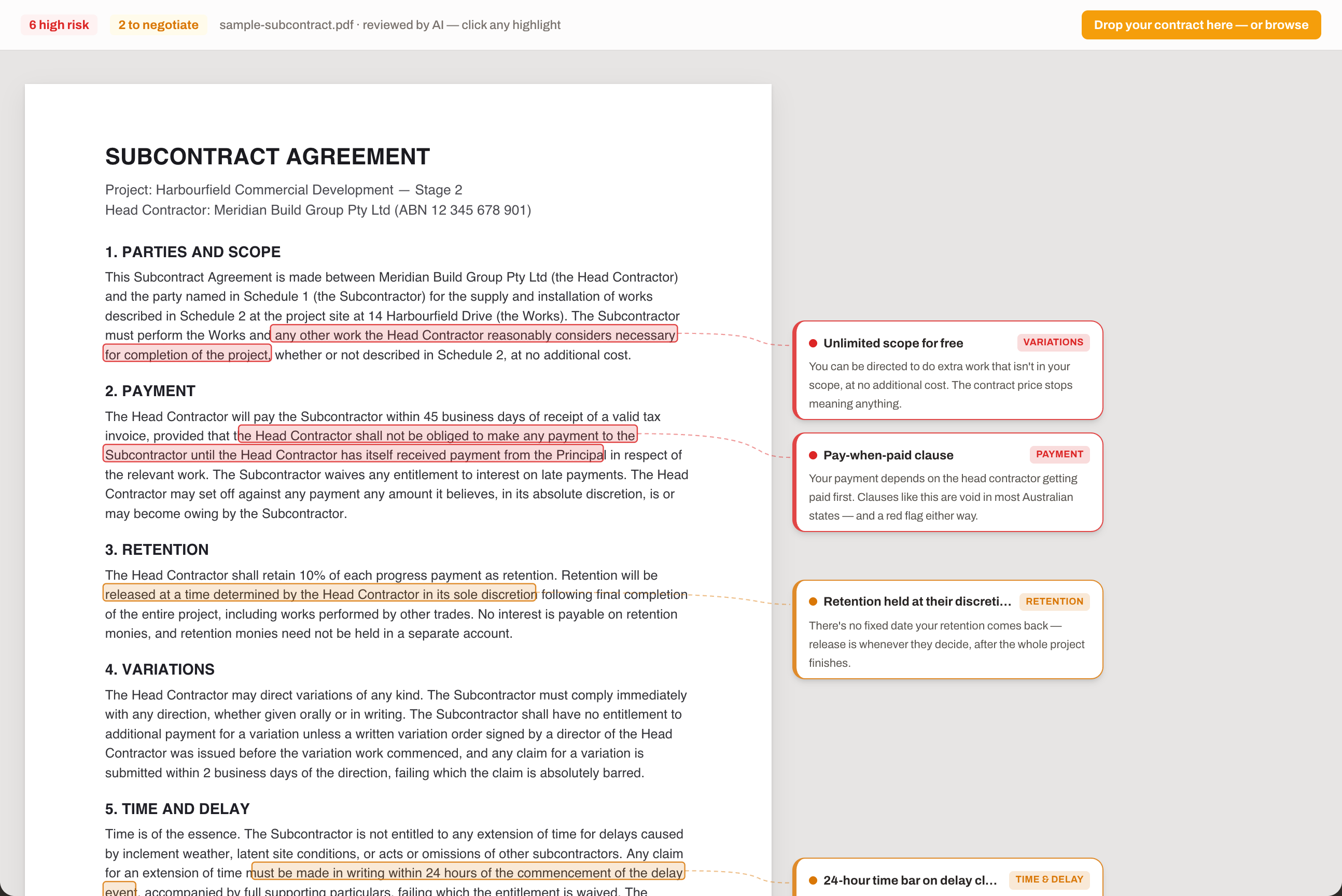
A reviewed construction subcontract in ContractorCounter Review: risky clauses highlighted on the page with margin callouts for pay-when-paid, uncapped liquidated damages, and retention terms
The AI reads your contract before you pay — see a fully reviewed sample free
  • Monthly claims — no reference-date games
  • 20-business-day payment cap for subbies
  • No schedule → full amount owed
  • s 34 voids contracting-out clauses

What the Act guarantees

A payment claim on and from the last day of each named month (since the 2019 reforms removed reference-date games), including after termination. The respondent has 10 business days to serve a payment schedule; without one, it's liable for the full claimed amount, recoverable as a debt with contract defences barred. Subcontractors must be paid within 20 business days of a claim — clauses allowing later payment have no effect (s 11(8)).

Pay-when-paid is void

Section 12 gives pay-when-paid provisions no effect, defined broadly: any clause making your payment or its timing contingent on the head contractor being paid, or on anything under another contract. Head contractors serving claims upstream must also attach a supporting statement declaring subcontractors have been paid — the Act polices the chain in both directions.

What contracts still try

Payment terms longer than 20 business days (void), claim-form preconditions designed to invalidate claims, deeming clauses that shrink your response windows — the Supreme Court voided one under s 34 in 2025 (Sharvain Facades v Roberts Co) — and dispute-resolution preconditions that delay adjudication. Note what s 34 doesn't do: it isn't a blanket rule against EOT time bars, which generally stand in NSW if clearly drafted.

Make the Act work for you

State on every claim that it's made under the Act, claim every month, diarise the 10-business-day schedule window, and adjudicate promptly when schedules don't come. Then review the contract for what the Act doesn't override — LD caps, retention terms, indemnities — because statute protects payment, not margin. A $19 review covers both halves.

Common questions

Short answers for contractors

What payment terms can a NSW subcontract legally impose?

For subcontractors, payment is due no later than 20 business days after a payment claim is made (s 11(1B)); head contractors must be paid by principals within 15 business days. Any clause providing for later payment has no effect under s 11(8) — a '45 days end of month' term in a NSW subcontract is simply overridden. The contract can provide shorter terms, never longer.

What happens if no payment schedule is served in NSW?

The respondent becomes liable for the full claimed amount on the due date. You can recover it as a debt in court — where the respondent is barred from raising cross-claims or contract defences (s 15(4)) — or take it to adjudication. The 10-business-day schedule window (or shorter if the contract says so) is the respondent's only chance to dispute the valuation for that claim.

Are time bar clauses void under NSW Security of Payment?

Not as a category. Section 34 voids provisions that exclude, modify, or restrict the Act or deter you from using it — courts have struck down notice-deeming clauses and adjudication obstacles on that basis — but a clearly drafted time bar on contractual EOT or variation claims generally stands. Treat NSW time bars as enforceable: run notice discipline, and negotiate the windows before signing.

How much does an AI construction contract review cost?

ContractorCounter Review costs a flat US$19 per contract, whatever the page count — no subscription, no account, no demo call. The AI reads the contract and shows you what it found (how many issues, how severe, on which pages) before you pay anything; the $19 unlocks the full marked-up review with every clause highlighted and a plain-English concern and negotiation ask for each.

Is my contract kept private?

The contract PDF never leaves your browser — only its extracted text is processed to produce the review, and it is not used to train AI models. Findings are stored temporarily to deliver your purchase (7 days unpurchased, 30 days after unlock) and then deleted automatically.

Is this legal advice?

No. ContractorCounter Review is an AI-powered first-pass review that flags risky, one-sided, and ambiguous clauses so you know exactly what to question. It is not a law firm and its output is not legal advice — for contracts worth serious money, take the marked-up review to a construction lawyer and spend their billable hours on judgment instead of reading.

Get your first takeoff done in minutes

Open a plan set, mark it up, and take quantities off the sheet — in your browser, on any device, with nothing to install.

Start free trial

14-day free trial · No credit card required