Liquidated damages caps

Capping Liquidated Damages in Your Subcontract

Liquidated damages fix a daily or weekly rate you owe for late completion. Uncapped, they're an unlimited bet against the program: a $2,000-a-day rate with no ceiling turns a six-week delay — even one only partly yours — into an $84,000 exposure on a job you priced at a fraction of that margin. The industry-standard fix is a cap of 5–10% of the contract sum.

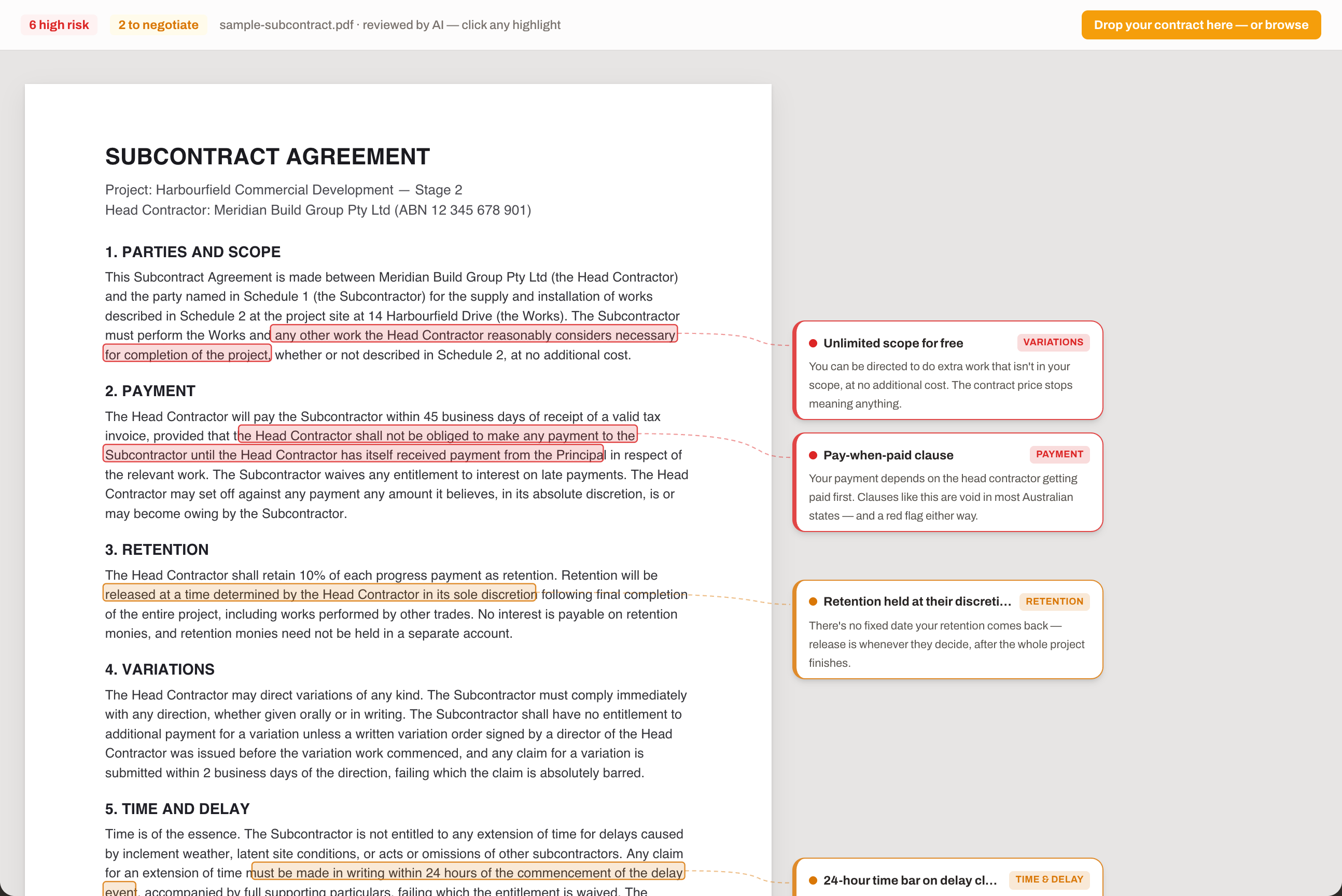
A reviewed construction subcontract in ContractorCounter Review: risky clauses highlighted on the page with margin callouts for pay-when-paid, uncapped liquidated damages, and retention terms
The AI reads your contract before you pay — see a fully reviewed sample free
  • 5–10% aggregate cap benchmark
  • Flow-down proportionality check
  • Exclusive-remedy and EOT pairing
  • AI reads your LD exposure for $19

What LDs are and why they exist

LDs replace arguing about actual delay losses with a pre-agreed rate — that certainty genuinely helps both sides. The clause turns hostile in two ways: a rate out of proportion to any genuine loss estimate, and the absence of any aggregate cap, which converts a normal commercial term into unlimited liability on your smallest-margin line of work.

The flow-down trap

Head contracts pass LD exposure down: your subcontract inherits a rate derived from the whole project's delay cost, applied to your slice of the work. A roofing sub carrying the tower's $10,000-a-day LDs is carrying risk priced for a balance sheet twenty times larger. Ask what the head contract rate is, and insist your exposure is proportional to your scope — the same discipline applies to one-sided indemnities flowing down beside it.

The asks that work

One: an aggregate cap — 5–10% of the subcontract sum is the widely used range. Two: LDs as the exclusive remedy for delay, so general damages can't be stacked on top. Three: a matching EOT regime — every cause of delay outside your control listed as a ground for extension, because time bars and EOT notices decide whether the LD clause ever actually bites. The cap negotiation playbook covers the counter-asks too. If they refuse any cap, that tells you how they expect the job to go.

Check the other direction too

If your delay costs them a fixed rate, their delay should cost them something as well: delay damages or prolongation costs payable to you when the program moves for reasons that aren't yours. A full subcontract review reads the LD clause together with the EOT, variation, and notice clauses — in isolation each looks survivable; combined is where the margin goes.

Common questions

Short answers for contractors

What is a reasonable cap on liquidated damages?

The widely used range in subcontracting is 5–10% of the contract sum as an aggregate ceiling. Within that, check the daily rate is a genuine pre-estimate of the loss your delay would cause — not the whole project's delay cost flowed down onto your trade — and that LDs are expressed as the exclusive remedy for delay so general damages can't be claimed on top.

Should I ever accept uncapped liquidated damages?

It's the single most dangerous term a subcontractor routinely signs: exposure limited only by how long the delay runs, on rates you didn't set, for delays that may only partly be yours. If the counterparty won't accept any cap, price the risk explicitly, tighten your EOT and notice discipline so entitlements survive, and decide whether the margin justifies an unlimited downside. Most of the time, a 10% cap is accepted when actually asked for.

How do liquidated damages interact with extensions of time?

The EOT clause is the LD clause's off-switch: every day of extension is a day LDs can't run. That's why the same contracts that carry heavy LD rates also carry short time bars on EOT claims — miss the 5-day notice window and the extension you were entitled to disappears, leaving the LD clock running. Read the two clauses as one mechanism, and never sign a heavy LD rate next to a tight time bar without negotiating one of them.

How much does an AI construction contract review cost?

ContractorCounter Review costs a flat US$19 per contract, whatever the page count — no subscription, no account, no demo call. The AI reads the contract and shows you what it found (how many issues, how severe, on which pages) before you pay anything; the $19 unlocks the full marked-up review with every clause highlighted and a plain-English concern and negotiation ask for each.

Is my contract kept private?

The contract PDF never leaves your browser — only its extracted text is processed to produce the review, and it is not used to train AI models. Findings are stored temporarily to deliver your purchase (7 days unpurchased, 30 days after unlock) and then deleted automatically.

Is this legal advice?

No. ContractorCounter Review is an AI-powered first-pass review that flags risky, one-sided, and ambiguous clauses so you know exactly what to question. It is not a law firm and its output is not legal advice — for contracts worth serious money, take the marked-up review to a construction lawyer and spend their billable hours on judgment instead of reading.

Get your first takeoff done in minutes

Open a plan set, mark it up, and take quantities off the sheet — in your browser, on any device, with nothing to install.

Start free trial

14-day free trial · No credit card required