Pay-when-paid clauses

Pay-When-Paid Clauses: What They Mean and How to Push Back

A pay-when-paid clause makes your payment contingent on the head contractor being paid first — their client's cash-flow problem becomes yours. These clauses are void or ineffective in Australia, the UK, and New Zealand, tightly channelled in Canada, and enforceable in many US states only when clearly drafted. They still appear in contracts everywhere, because unchallenged clauses work anyway.

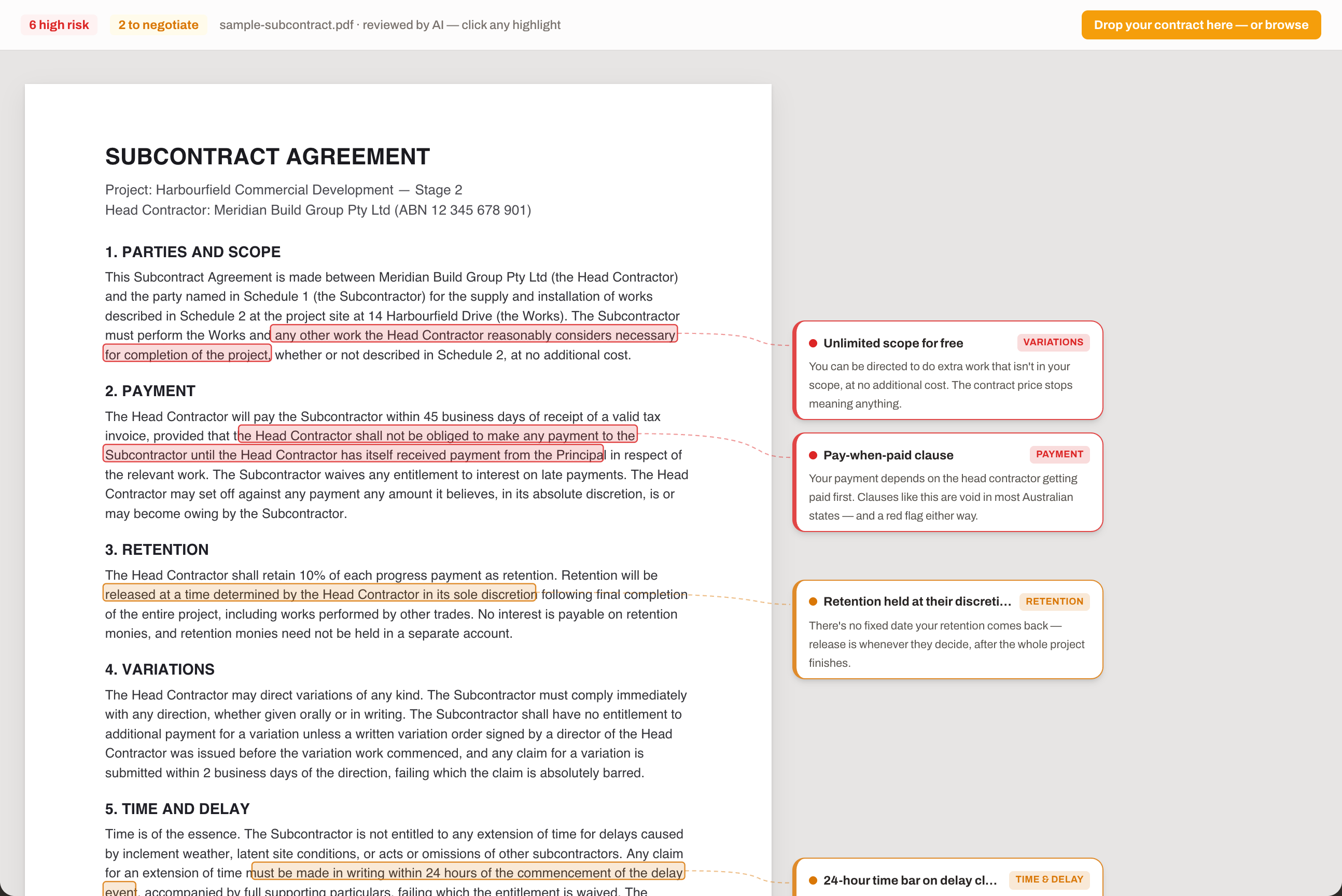
A reviewed construction subcontract in ContractorCounter Review: risky clauses highlighted on the page with margin callouts for pay-when-paid, uncapped liquidated damages, and retention terms
The AI reads your contract before you pay — see a fully reviewed sample free
  • Definition and pay-if-paid distinction
  • Five-market legal treatment
  • Concrete push-back wording
  • AI flags it in your contract for $19

Pay-when-paid vs pay-if-paid

Pay-when-paid delays the timing of your payment until money arrives from upstream; pay-if-paid makes upstream payment a condition of you being paid at all — if the owner never pays, you never get paid. US courts construe ambiguous wording as mere timing, which is why drafters who mean pay-if-paid say 'condition precedent' explicitly. Either way, the clause moves a credit risk you didn't price onto your balance sheet.

Where the law bans them outright

Australia: every state security-of-payment Act gives conditional-payment provisions no effect (NSW s 12, QLD s 74, VIC s 13, WA s 14). The UK Construction Act renders them ineffective except where the upstream party is insolvent (s 113) — and the 2009 amendments caught pay-when-certified variants too. New Zealand's Construction Contracts Act voids all conditional payment provisions (s 13). If you're in these markets, the clause is unenforceable — see your statutory payment rights — but leaving it in still invites payment games.

The US and Canada: it depends, so check

In the US it varies by state: pay-if-paid is void in California, New York, Virginia (contracts from 2023), and Delaware private work, while a majority of states enforce clearly drafted conditions — US payment rights covers the landscape. In Ontario, the Construction Act doesn't ban the clause but forces it through a strict channel: a contractor who wants to defer payment for owner non-payment must give a formal notice and undertake to adjudicate within 21 days — see Canada's prompt-payment regime.

How to push back

Ask for the clause to be deleted, or replaced with a fixed payment period from your invoice ('within 20 business days of the payment claim'). If they insist, cap the deferral ('no more than 30 days regardless of upstream payment') and add interest. Our five-market pay-when-paid guide walks the negotiation in detail, and a full contract review will also catch the related traps — set-off rights and notice preconditions that do the same damage by another route.

Common questions

Short answers for contractors

What does a pay-when-paid clause mean?

It means the party above you doesn't have to pay you until they've been paid from above — your cash flow depends on a contract you never saw and a payer you can't chase. In its stronger 'pay-if-paid' form, upstream payment is a condition of your entitlement, so owner insolvency can wipe out money you've already earned. The clause shifts credit risk from the party best placed to manage it (the head contractor, who chose the client) to the party least placed (you).

Are pay-when-paid clauses enforceable?

Depends where you are. Australia (every state), the UK (except upstream insolvency), and New Zealand render them void or ineffective by statute. Ontario doesn't ban them but requires a formal notice-of-non-payment plus an undertaking to adjudicate before payment can be deferred. In the US, California, New York, Virginia, and Delaware (private work) void pay-if-paid conditions, while many other states enforce them if the wording is unmistakably clear. Unenforceable or not, the clause causes real-world payment delay wherever it survives in the document unchallenged.

Should I sign a contract with a pay-when-paid clause?

Push back first — deletion or a fixed payment period is a normal ask, and in banned jurisdictions you're only asking them to remove something the law already voids. If you do sign with it in (in a market where it's enforceable), price the credit risk: know who the ultimate payer is, keep claims current, and use every statutory payment right on time.

How much does an AI construction contract review cost?

ContractorCounter Review costs a flat US$19 per contract, whatever the page count — no subscription, no account, no demo call. The AI reads the contract and shows you what it found (how many issues, how severe, on which pages) before you pay anything; the $19 unlocks the full marked-up review with every clause highlighted and a plain-English concern and negotiation ask for each.

Is my contract kept private?

The contract PDF never leaves your browser — only its extracted text is processed to produce the review, and it is not used to train AI models. Findings are stored temporarily to deliver your purchase (7 days unpurchased, 30 days after unlock) and then deleted automatically.

Is this legal advice?

No. ContractorCounter Review is an AI-powered first-pass review that flags risky, one-sided, and ambiguous clauses so you know exactly what to question. It is not a law firm and its output is not legal advice — for contracts worth serious money, take the marked-up review to a construction lawyer and spend their billable hours on judgment instead of reading.

Get your first takeoff done in minutes

Open a plan set, mark it up, and take quantities off the sheet — in your browser, on any device, with nothing to install.

Start free trial

14-day free trial · No credit card required