WA Security of Payment

WA Security of Payment: Contract Clauses to Watch

Western Australia's Building and Construction Industry (Security of Payment) Act 2021 brought WA into line with the east coast — and went further: it was the first Australian Act to let adjudicators strike down unfair notice-based time bars. It applies to construction contracts entered into from 1 August 2022; older contracts stay under the former Construction Contracts Act regime.

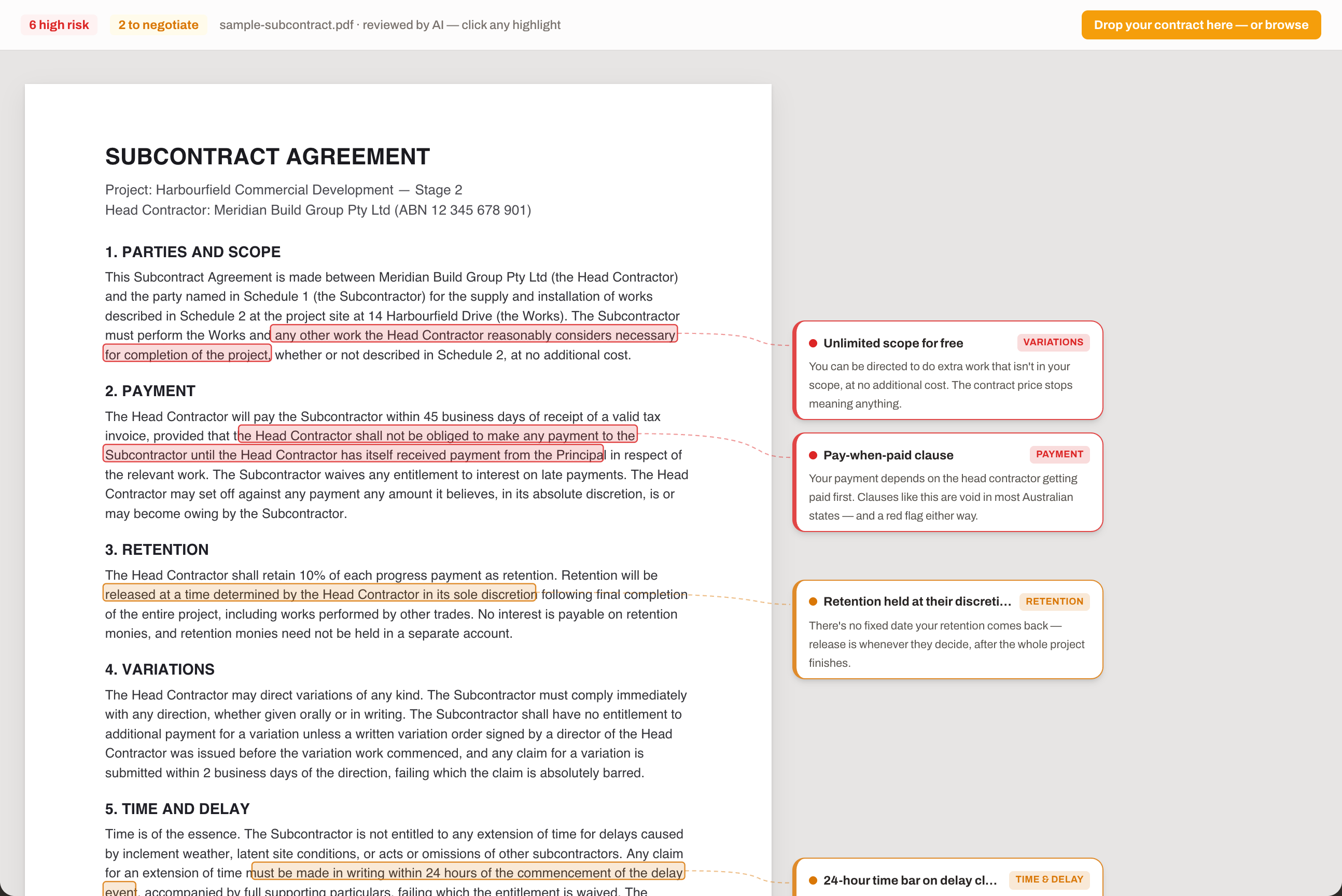
A reviewed construction subcontract in ContractorCounter Review: risky clauses highlighted on the page with margin callouts for pay-when-paid, uncapped liquidated damages, and retention terms
The AI reads your contract before you pay — see a fully reviewed sample free
  • 25-business-day cap on subbie payment
  • Unfair time bars voidable (s 16)
  • Retention held on trust from $20k
  • Pay-when-paid void (s 14)

What the Act guarantees

Monthly payment claims (s 23), a payment schedule within 15 business days of the claim (s 25), and full liability for the claimed amount if no schedule arrives — enforceable as a debt or through adjudication, with a second chance to adjudicate if a late schedule appears. Payment terms are capped: 20 business days from principal to head contractor, 25 business days for payments to subcontractors (s 20).

Australia's first unfair time bar rule

Section 16 lets an adjudicator, review adjudicator, court, arbitrator, or expert declare a notice-based time bar unfair — and of no effect for that entitlement — where compliance isn't reasonably possible or would be unreasonably onerous, weighing factors like bargaining power and when you could reasonably have known of the event. Victoria copied the mechanism in 2026. It rescues impossible cases; routine notice discipline still decides the rest.

Pay-when-paid and contracting out

Pay-when-paid provisions have no effect (s 14), and s 111 voids provisions that exclude, limit, or modify the Act — including anything reasonably construable as deterring you from using it. If a WA subcontract ties your money to upstream payment or buries the Act's timelines under contractual process, those clauses don't survive contact with the statute.

Retention trusts, and what to still negotiate

WA's retention money trust scheme requires cash retention to be held in trust — covering contracts over $1 million from February 2023 and over $20,000 from February 2024 — protecting it in the payer's insolvency. The Act doesn't touch LD caps, indemnities, scope, or termination terms: statute secures the payment pipe; the contract still sets the commercial risk. Review both before signing.

Common questions

Short answers for contractors

Which contracts does WA's Security of Payment Act 2021 cover?

Construction contracts entered into on or after 1 August 2022 — the Act commenced in stages from that date, with the trust provisions following in 2023 and 2024. Contracts signed earlier remain under the former Construction Contracts Act 2004 regime, which runs on different timeframes and adjudication rules, so the first question for any WA payment dispute is simply: when was the contract signed?

Can a WA contract impose a 45-day payment term?

Not effectively. Section 20 caps payment terms: a principal must pay a head contractor within 20 business days and a subcontractor must be paid within 25 business days — terms providing for later payment are overridden. Combined with the 15-business-day payment schedule deadline and full liability where no schedule is served, the Act sets the payment rhythm regardless of what the subcontract's payment clause says.

When is a time bar 'unfair' under WA's s 16?

When complying with it was not reasonably possible or would be unreasonably onerous in the circumstances — assessed against factors including the parties' bargaining power and when the claiming party could reasonably have known of the delay event. The onus is on the party alleging unfairness, and the declaration only neutralises the time bar for that entitlement. It's a case-by-case shield for impossible notice windows, not a repeal of time bars.

How much does an AI construction contract review cost?

ContractorCounter Review costs a flat US$19 per contract, whatever the page count — no subscription, no account, no demo call. The AI reads the contract and shows you what it found (how many issues, how severe, on which pages) before you pay anything; the $19 unlocks the full marked-up review with every clause highlighted and a plain-English concern and negotiation ask for each.

Is my contract kept private?

The contract PDF never leaves your browser — only its extracted text is processed to produce the review, and it is not used to train AI models. Findings are stored temporarily to deliver your purchase (7 days unpurchased, 30 days after unlock) and then deleted automatically.

Is this legal advice?

No. ContractorCounter Review is an AI-powered first-pass review that flags risky, one-sided, and ambiguous clauses so you know exactly what to question. It is not a law firm and its output is not legal advice — for contracts worth serious money, take the marked-up review to a construction lawyer and spend their billable hours on judgment instead of reading.

Get your first takeoff done in minutes

Open a plan set, mark it up, and take quantities off the sheet — in your browser, on any device, with nothing to install.

Start free trial

14-day free trial · No credit card required