Time bars & EOT notices

Time Bars & EOT Notices: Don't Lose Your Claim

A time bar clause extinguishes a claim unless you give notice within a fixed window — sometimes as short as 48 hours from the delaying event. It's the quietest way subcontractors lose money: not by doing bad work, but by doing the paperwork three days late. Standard forms like AS4000 allow 28 days for an EOT claim; aggressive subcontracts cut that to 5 or 7, then add a second notice as a further precondition.

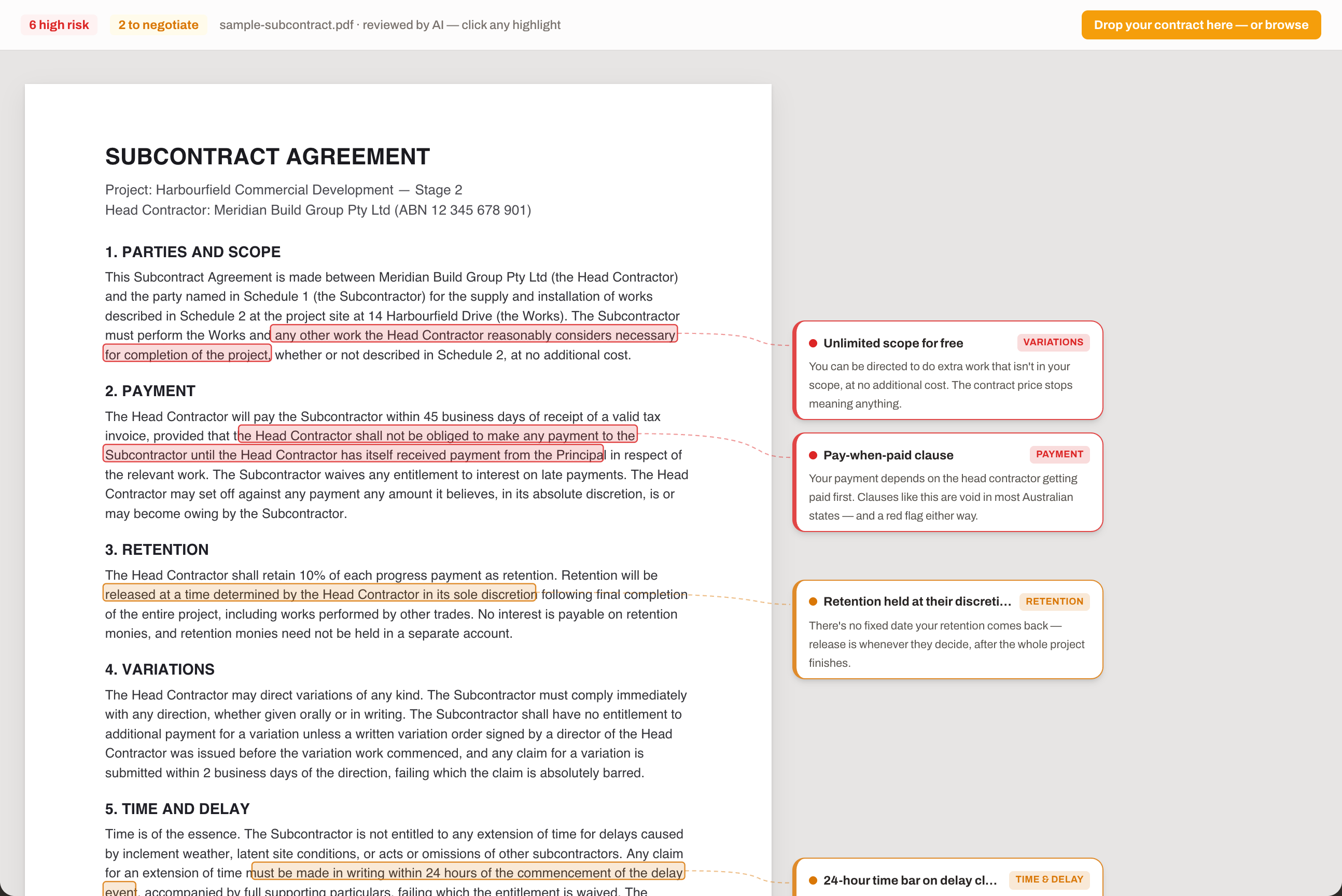
A reviewed construction subcontract in ContractorCounter Review: risky clauses highlighted on the page with margin callouts for pay-when-paid, uncapped liquidated damages, and retention terms
The AI reads your contract before you pay — see a fully reviewed sample free
  • Every notice obligation extracted
  • Layered time-bar traps flagged
  • WA/VIC unfair-time-bar rights explained
  • Notice-first strategy templates

How time bars actually operate

The clause makes notice a condition precedent: no notice in time, no entitlement — regardless of merit. Watch for the layered version: an initial notice within days of the event, detailed particulars within another window, and updated particulars monthly, where missing any layer bars the claim. Count every distinct notice obligation in the contract before signing; finding six is common, and each one is a tripwire.

Where unfair time bars can be challenged

Western Australia pioneered a statutory answer: under its Security of Payment Act 2021 (s 16), an adjudicator or court can declare a notice-based time bar unfair — and of no effect for that claim — where compliance wasn't reasonably possible or would be unreasonably onerous. Victoria adopted the same mechanism in its April 2026 reforms (s 13A), covering payment, EOT, and security-release notices. Elsewhere, including NSW and QLD, there's no blanket rule voiding time bars — clauses that obstruct statutory payment rights can fall foul of anti-contracting-out provisions, but a well-drafted EOT time bar generally stands. Assume it will be enforced.

Negotiate the regime before signing

Ask for: 10–20 business days for initial notices (measured from when you became aware, not when the event occurred), 'notice-first, particulars-later' so a short holding notice preserves the claim, and no time bars on statutory rights. Pair every ask with the LD cap conversation — a heavy LD rate beside a 5-day EOT bar is one mechanism designed to run out your entitlements.

Run the discipline after signing

Whatever survives negotiation, build it into site routine: a one-page notice template, a deadline list per contract, and a default of 'notice everything, withdraw later'. A brief protective notice costs five minutes; a barred claim costs the whole entitlement — how subbies lose money they've earned walks the discipline in full. ContractorCounter Review extracts every notice obligation and time bar in the document so the deadline list writes itself.

Common questions

Short answers for contractors

What is a time bar clause in a construction contract?

A clause that makes timely written notice a condition of a claim — for an extension of time, a variation, or delay costs — so that missing the notice window extinguishes the entitlement entirely, however valid the underlying claim. Windows range from 28 days in standard forms like AS4000 down to 48 hours in aggressive subcontracts, and many contracts stack multiple notice layers where missing any one bars the claim.

Are time bar clauses enforceable?

Generally yes, if clearly drafted — courts enforce conditions precedent, which is exactly why they're used. The exceptions are specific: WA's Security of Payment Act 2021 (s 16) and Victoria's 2026 reforms (s 13A) let adjudicators and courts declare a notice-based time bar unfair and of no effect where compliance wasn't reasonably possible or would be unreasonably onerous; and clauses that operate to defeat statutory payment rights can be void under anti-contracting-out provisions like NSW's s 34. Outside those lanes, plan on the time bar being enforced as written.

How do I protect claims under a contract with short time bars?

Treat notices as production work, not admin. Extract every notice obligation and deadline into one list the day you sign; use a standing one-page notice template; measure deadlines from the event, not from when you got around to it; and when in doubt, send a short protective notice — 'we notify a delay event occurred on [date]; particulars follow' — because notice-first-particulars-later preserves claims that silence kills.

How much does an AI construction contract review cost?

ContractorCounter Review costs a flat US$19 per contract, whatever the page count — no subscription, no account, no demo call. The AI reads the contract and shows you what it found (how many issues, how severe, on which pages) before you pay anything; the $19 unlocks the full marked-up review with every clause highlighted and a plain-English concern and negotiation ask for each.

Is my contract kept private?

The contract PDF never leaves your browser — only its extracted text is processed to produce the review, and it is not used to train AI models. Findings are stored temporarily to deliver your purchase (7 days unpurchased, 30 days after unlock) and then deleted automatically.

Is this legal advice?

No. ContractorCounter Review is an AI-powered first-pass review that flags risky, one-sided, and ambiguous clauses so you know exactly what to question. It is not a law firm and its output is not legal advice — for contracts worth serious money, take the marked-up review to a construction lawyer and spend their billable hours on judgment instead of reading.

Get your first takeoff done in minutes

Open a plan set, mark it up, and take quantities off the sheet — in your browser, on any device, with nothing to install.

Start free trial

14-day free trial · No credit card required