Subcontract review

Subcontract Review: What to Check Before You Sign

Before you sign a subcontract, check eight things: payment terms, retention, liquidated damages, time bars, indemnities, scope and variations, termination rights, and dispute resolution. Every one of them is routinely written against the subcontractor — and every one is negotiable before you sign, and almost none of it after.

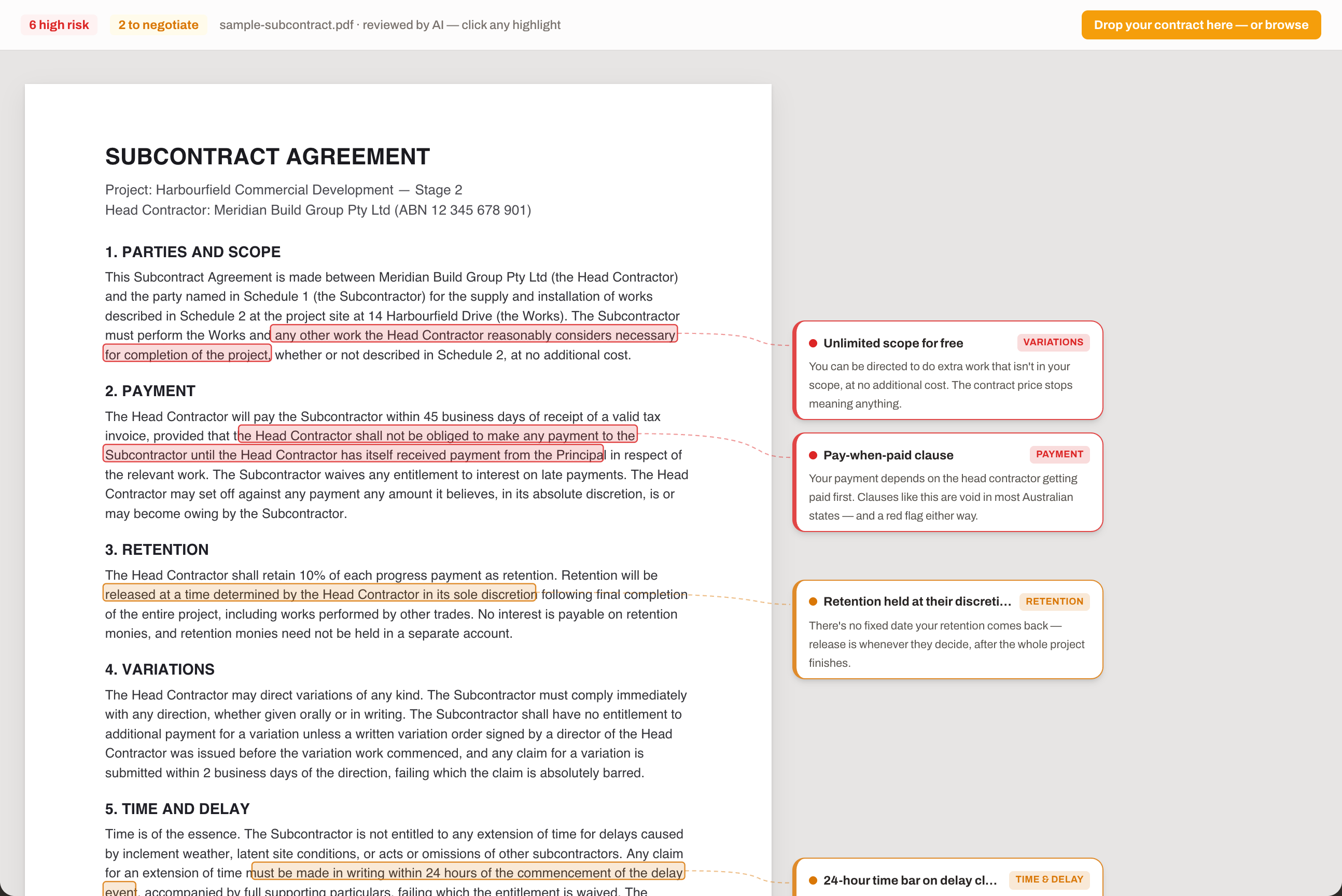
A reviewed construction subcontract in ContractorCounter Review: risky clauses highlighted on the page with margin callouts for pay-when-paid, uncapped liquidated damages, and retention terms
The AI reads your contract before you pay — see a fully reviewed sample free
  • Eight-point subcontract checklist
  • AI reads every clause in minutes
  • Findings pinned to the contract page
  • US$19 flat — no subscription

Why review before signing, not after

A subcontract is drafted by the head contractor's side, for the head contractor's benefit — signing it unread means accepting their version of every risk. Once signed, you renegotiate from weakness; before signing, a one-line email ("we need a cap on LDs and 20-business-day payment terms") is normal commercial behaviour that good head contractors expect.

The ten-minute first pass

Read three clauses before anything else: payment (is there a pay-when-paid clause?), liquidated damages (is there a cap?), and notices (are there time bars shorter than 10 business days?). Those three decide whether the contract can hurt you faster than you can invoice.

Let the AI read all of it

The checklist below is what ContractorCounter Review runs across the whole document in minutes — every finding highlighted on the contract page with a plain-English concern and a concrete ask, for US$19. It reads the whole contract so you spend your attention on the clauses that matter.

When to bring in a lawyer

High contract value, unusual risk (design responsibility, hazardous work), or terms the other side refuses to move on — that's lawyer territory. Take the marked-up review with you: AI review vs a construction lawyer covers how the two fit together.

Subcontract review checklist

  1. 1

    Payment terms

    Find the payment clause. Flag pay-when-paid or pay-if-paid wording (void in many jurisdictions but still drafted in), payment periods longer than your market's statutory cap, and set-off rights that let them deduct disputed amounts from anything they owe you.

  2. 2

    Retention

    Check the percentage (5% is common; more is a red flag), the release triggers, and whether release dates are tied to events you don't control — like the head contract's final certificate. See retention clause games in detail.

  3. 3

    Liquidated damages

    Look for a daily LD rate with no cap, and LDs flowing down from the head contract out of proportion to your scope. Ask for a cap of 5–10% of the subcontract sum.

  4. 4

    Time bars and notices

    Find every clause that says a claim is barred unless notice is given within N days. Short time bars (48 hours, 5 days) on EOT and variation claims are the most common way subcontractors lose money they're owed.

  5. 5

    Indemnities and insurance

    Flag any indemnity that covers the other party's own negligence, and check the insurance clause asks for cover you actually hold. An uninsurable indemnity is a bet-the-company clause.

  6. 6

    Scope and variations

    The scope should be specific enough that extra work is clearly a variation. Check who can direct variations, whether verbal directions count, and how quickly you must price them.

  7. 7

    Termination

    Check for termination-for-convenience with no compensation for lost margin, and cure periods short enough that any dispute becomes a default.

  8. 8

    Dispute resolution

    Note the process and forum. Preconditions that delay adjudication, or a governing law and forum in another state or country, raise the cost of ever getting paid.

Common questions

Short answers for contractors

What should I check before signing a subcontract?

Eight things: payment terms (pay-when-paid wording, payment period, set-off), retention (percentage and release triggers), liquidated damages (rate and cap), time bars on claims and notices, indemnities and matching insurance, scope and variation procedure, termination rights, and dispute resolution. The three fastest checks are payment, LD cap, and time bars — they decide most of the financial risk.

How long does a subcontract review take?

A manual first pass on the key clauses takes 10–30 minutes if you know what to look for. ContractorCounter Review reads the full document — every page, every clause — in about 30–90 seconds and pins each finding to the page it appears on, so your time goes into decisions instead of reading.

What if I've already signed?

Review it anyway. You can't renegotiate signed terms, but you can manage them: know every notice deadline and time bar so you don't lose claims, invoice to the contractual rhythm, and check what your market's security-of-payment or prompt-payment law overrides regardless of what the contract says.

How much does an AI construction contract review cost?

ContractorCounter Review costs a flat US$19 per contract, whatever the page count — no subscription, no account, no demo call. The AI reads the contract and shows you what it found (how many issues, how severe, on which pages) before you pay anything; the $19 unlocks the full marked-up review with every clause highlighted and a plain-English concern and negotiation ask for each.

Is my contract kept private?

The contract PDF never leaves your browser — only its extracted text is processed to produce the review, and it is not used to train AI models. Findings are stored temporarily to deliver your purchase (7 days unpurchased, 30 days after unlock) and then deleted automatically.

Is this legal advice?

No. ContractorCounter Review is an AI-powered first-pass review that flags risky, one-sided, and ambiguous clauses so you know exactly what to question. It is not a law firm and its output is not legal advice — for contracts worth serious money, take the marked-up review to a construction lawyer and spend their billable hours on judgment instead of reading.

Get your first takeoff done in minutes

Open a plan set, mark it up, and take quantities off the sheet — in your browser, on any device, with nothing to install.

Start free trial

14-day free trial · No credit card required