NZ Construction Contracts Act

NZ Construction Contracts Act: Payment Claims That Stick

New Zealand's Construction Contracts Act 2002 has the cleanest payment architecture in the five markets ContractorCounter Review covers: serve a valid payment claim, and the payer either responds with a payment schedule in time or becomes liable for the full claimed amount as a debt. No contracting out (s 12), no conditional payment (s 13), and since 2023, retention money held on trust automatically.

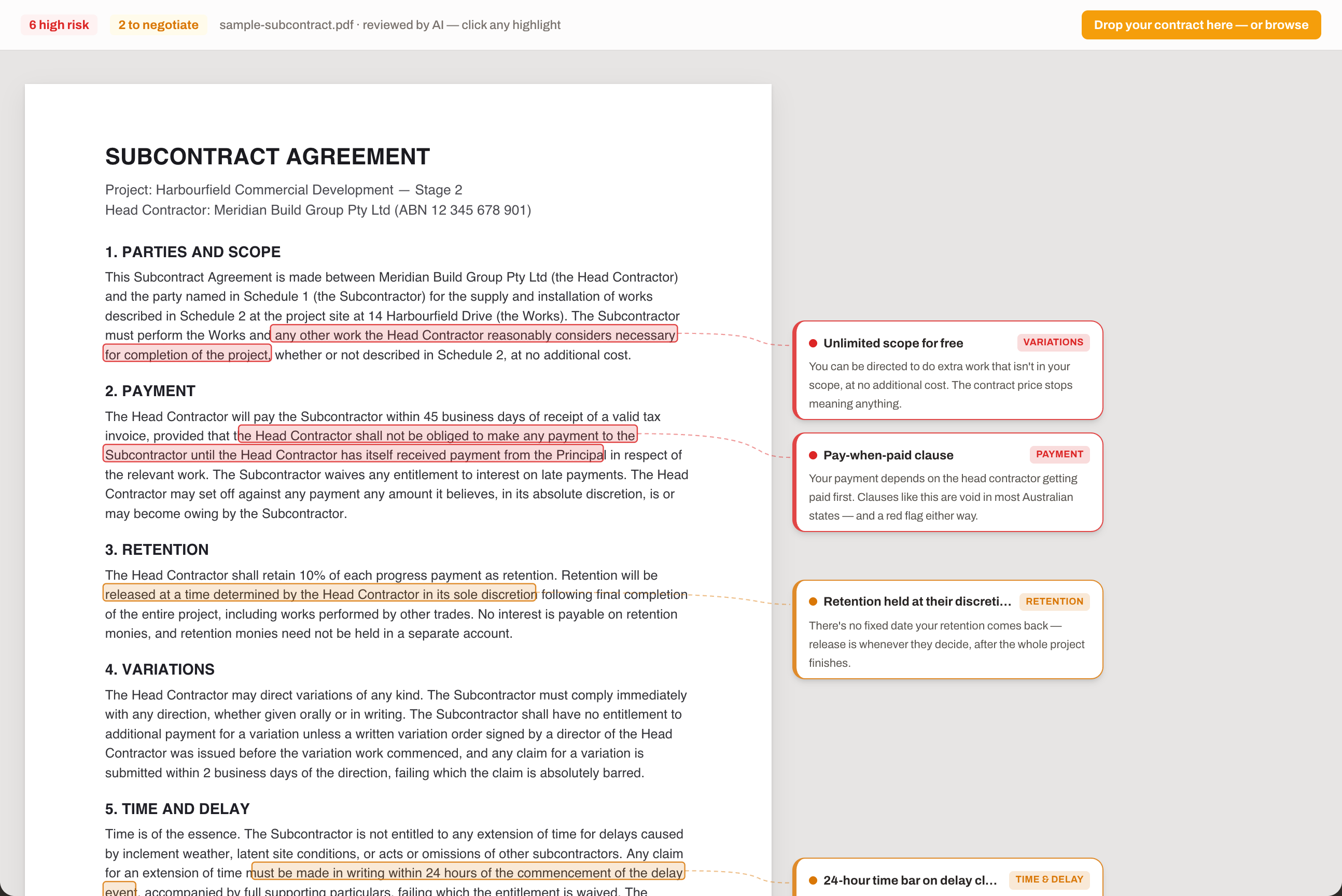
A reviewed construction subcontract in ContractorCounter Review: risky clauses highlighted on the page with margin callouts for pay-when-paid, uncapped liquidated damages, and retention terms
The AI reads your contract before you pay — see a fully reviewed sample free
  • No schedule → full claim becomes debt
  • s 12/s 13: no opt-out, no pay-when-paid
  • Retentions on statutory trust
  • Suspension after 5 working days

The payment claim / payment schedule engine

A payment claim under s 20 must be written, identify the contract and work, state the claimed amount and due date, show the calculation, and state that it's made under the Act. The payer's only defence to paying it is a payment schedule (s 21) served in time — by default 20 working days — stating what it will pay and precisely why anything is withheld. No schedule, no argument: the full claimed amount becomes a debt recoverable in court with your actual and reasonable recovery costs (ss 22–23).

No contracting out, no conditional payment

Section 12 is absolute: the Act has effect despite any provision to the contrary. Section 13 voids every conditional payment provision — pay-when-paid, pay-if-paid, due dates contingent on upstream events, and clauses making retention release conditional on anything other than your own performance. Contracts still arrive with this wording; in NZ it's noise, but strike it so nobody runs the game anyway.

Retention money is trust money

Since the 2023 amendments (in force October 2023), retention money on commercial construction contracts is held on trust by operation of law — whether or not the payer does anything — in a compliant account with per-subcontractor records, and a receiver or liquidator steps in as trustee if the payer collapses. Clauses that defer release past your performance, or charge you fees for administering your own retention, are void (s 18I).

Suspension and adjudication

Unpaid on a claim with no schedule? You can suspend work 5 working days after notice (s 24A) — while suspended you're not in breach, you keep your rights, and you get an extension of time. Any dispute can go to adjudication (s 25) regardless of other proceedings. The engine only works if your claims are valid, which is where time bars and notice discipline come in — a $19 review maps every notice the contract demands.

Common questions

Short answers for contractors

What makes a payment claim valid under the NZ Construction Contracts Act?

Section 20: it must be in writing, identify the construction contract and the work, state the claimed amount and its due date, show how the amount was calculated, and state that it is made under the Construction Contracts Act 2002 — with the prescribed outline of the payer's obligations attached where required. Getting the formalities right matters because the whole enforcement engine (full liability absent a schedule, debt recovery, suspension) hangs off a valid claim.

What happens if no payment schedule is served in NZ?

The payer becomes liable for the full claimed amount. If no payment schedule arrives within the contract's response period — or 20 working days by default — the claimed sum is recoverable as a debt due in any court, together with your actual and reasonable costs of recovery, and you gain the right to suspend work after notice. The payer's arguments about valuation were due in the schedule; without one, they wait until later proceedings while the debt is paid.

Are retentions protected in New Zealand?

Yes — strongly, since October 2023. Retention money on commercial construction contracts is trust property by operation of law from the moment it's withheld: held in a compliant bank account with per-subcontractor ledgers, protected in the payer's insolvency (the receiver or liquidator becomes trustee), and shielded by s 18I, which voids clauses conditioning release on anything besides your own performance and bans charging you retention-administration fees.

How much does an AI construction contract review cost?

ContractorCounter Review costs a flat US$19 per contract, whatever the page count — no subscription, no account, no demo call. The AI reads the contract and shows you what it found (how many issues, how severe, on which pages) before you pay anything; the $19 unlocks the full marked-up review with every clause highlighted and a plain-English concern and negotiation ask for each.

Is my contract kept private?

The contract PDF never leaves your browser — only its extracted text is processed to produce the review, and it is not used to train AI models. Findings are stored temporarily to deliver your purchase (7 days unpurchased, 30 days after unlock) and then deleted automatically.

Is this legal advice?

No. ContractorCounter Review is an AI-powered first-pass review that flags risky, one-sided, and ambiguous clauses so you know exactly what to question. It is not a law firm and its output is not legal advice — for contracts worth serious money, take the marked-up review to a construction lawyer and spend their billable hours on judgment instead of reading.

Get your first takeoff done in minutes

Open a plan set, mark it up, and take quantities off the sheet — in your browser, on any device, with nothing to install.

Start free trial

14-day free trial · No credit card required