Retention clauses

Retention Clauses: Getting Your Money Released

A retention clause lets the payer hold back part of every progress payment — typically 5% of the contract sum — as security for defects. The percentage is rarely the problem; the release terms are. Retention becomes a loss when release is tied to events you don't control, defined vaguely, or left to the other side's discretion.

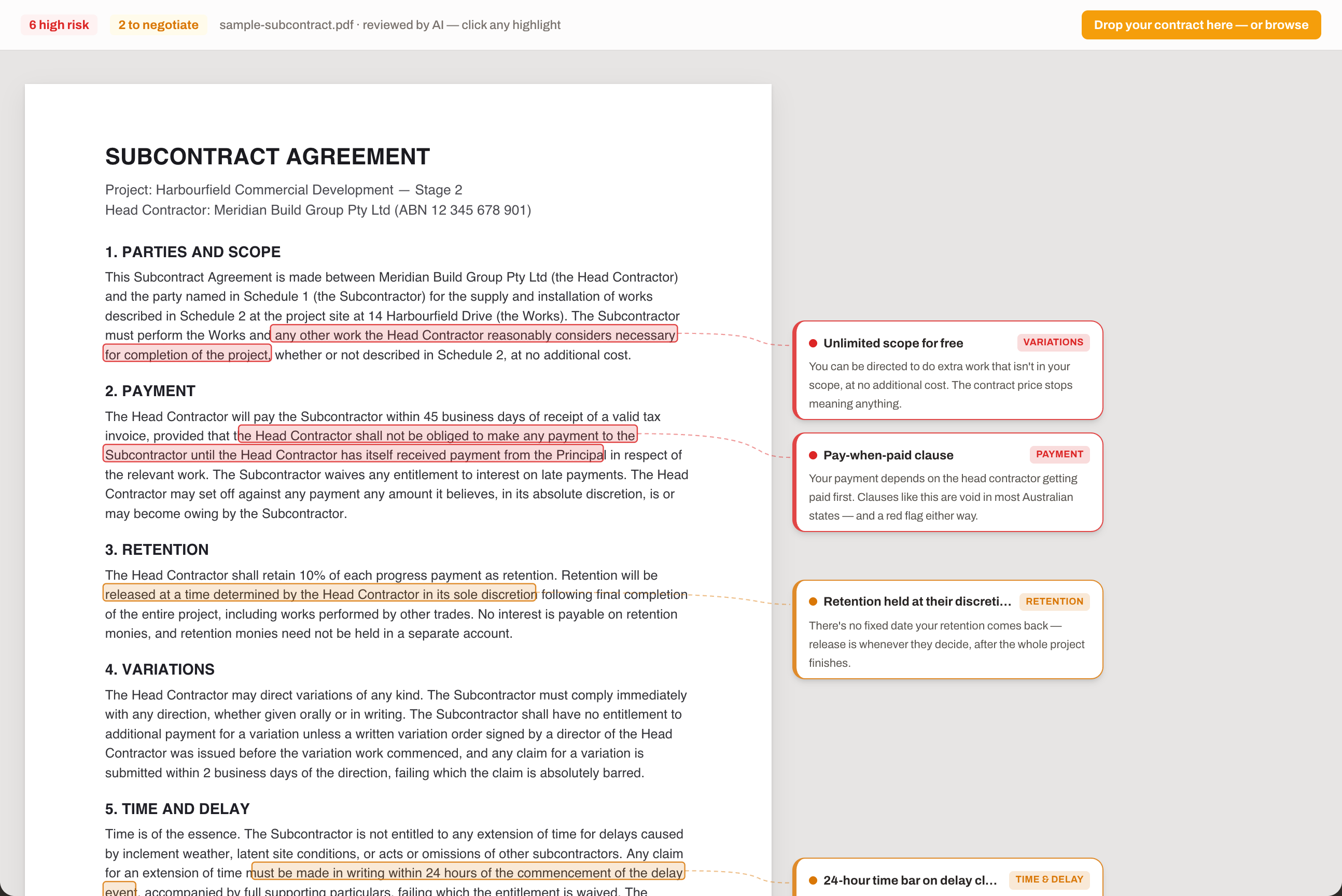
A reviewed construction subcontract in ContractorCounter Review: risky clauses highlighted on the page with margin callouts for pay-when-paid, uncapped liquidated damages, and retention terms
The AI reads your contract before you pay — see a fully reviewed sample free
  • Release-timing games decoded
  • Statutory trust protections by market
  • Negotiation asks with timeframes
  • AI checks your retention terms for $19

How retention is supposed to work

The payer withholds a small percentage from each progress claim, releases half at practical completion, and the rest at the end of the defects liability period. It's security for fixing defects — not free working capital for the head contractor. The test for any retention clause: can you name the calendar date, or the event within your control, when each half comes back?

The release games to look for

Release tied to the head contract ('when the principal releases retention to us') — that's a pay-when-paid clause wearing a disguise. Release on 'final completion of the project' when your trade finished a year earlier. Discretionary wording ('may be released'). No deadline on the defects-period release. And retention percentages above 5%, or applied on top of bank guarantees, which double the security for the same risk.

What the law protects

New Zealand holds retention money on statutory trust — it's your money held for you, with the trust arising automatically and surviving the payer's insolvency, and clauses that condition release on anything but your own performance are void (s 18I). WA runs a retention trust scheme (contracts over $20,000 since Feb 2024), and Victoria's April 2026 reforms added a statutory right to claim release of performance security. Elsewhere the contract mostly governs — which is why the wording matters. See your market's page: NZ, WA, VIC.

What to ask for

Cap retention at 5%. Tie release to your practical completion and your defects period, with named timeframes ('within 10 business days of…'). Offer a bank guarantee swap if cash retention hurts — the retention release games guide covers each ask with wording. And check the time bar clauses — a short claim window plus slow retention release is how subbies end up funding the project twice.

Common questions

Short answers for contractors

What is a normal retention percentage in construction?

5% of the contract sum is the common benchmark, often released half at practical completion and half after the defects liability period. Higher percentages, retention on top of bank guarantees, or retention with no stated release timetable are the signals to negotiate. The percentage matters less than the release terms — 5% held for four years is worse than 10% released on schedule.

When must retention money be released?

Whatever the contract says — which is exactly the problem when it says 'upon release under the head contract' or names no deadline at all. Well-drafted clauses tie release to your own practical completion and your own defects period with fixed timeframes. In New Zealand, retention money is held on statutory trust and release can't lawfully be conditioned on anything besides your performance; WA's trust scheme and Victoria's 2026 security-release right add protection in those states.

Can I refuse retention entirely?

You can ask — some trades and small works contracts run retention-free, and offering a bank guarantee or retention bond instead of cash retention is a standard compromise that protects your cash flow while giving the payer real security. Whether it lands depends on leverage; what's always negotiable is the release wording, and that's where most of the money is lost.

How much does an AI construction contract review cost?

ContractorCounter Review costs a flat US$19 per contract, whatever the page count — no subscription, no account, no demo call. The AI reads the contract and shows you what it found (how many issues, how severe, on which pages) before you pay anything; the $19 unlocks the full marked-up review with every clause highlighted and a plain-English concern and negotiation ask for each.

Is my contract kept private?

The contract PDF never leaves your browser — only its extracted text is processed to produce the review, and it is not used to train AI models. Findings are stored temporarily to deliver your purchase (7 days unpurchased, 30 days after unlock) and then deleted automatically.

Is this legal advice?

No. ContractorCounter Review is an AI-powered first-pass review that flags risky, one-sided, and ambiguous clauses so you know exactly what to question. It is not a law firm and its output is not legal advice — for contracts worth serious money, take the marked-up review to a construction lawyer and spend their billable hours on judgment instead of reading.

Get your first takeoff done in minutes

Open a plan set, mark it up, and take quantities off the sheet — in your browser, on any device, with nothing to install.

Start free trial

14-day free trial · No credit card required