Indemnity clauses

One-Sided Indemnities: The Clause Insurers Hate

An indemnity clause makes you promise to cover someone else's losses. Reasonable when it tracks your own fault; dangerous when it's drafted to cover losses 'howsoever arising' — including those caused by the other party's own negligence. The test that cuts through the legalese: would your insurer pay a claim under this clause? An uninsurable indemnity is a promise to pay from your own pocket.

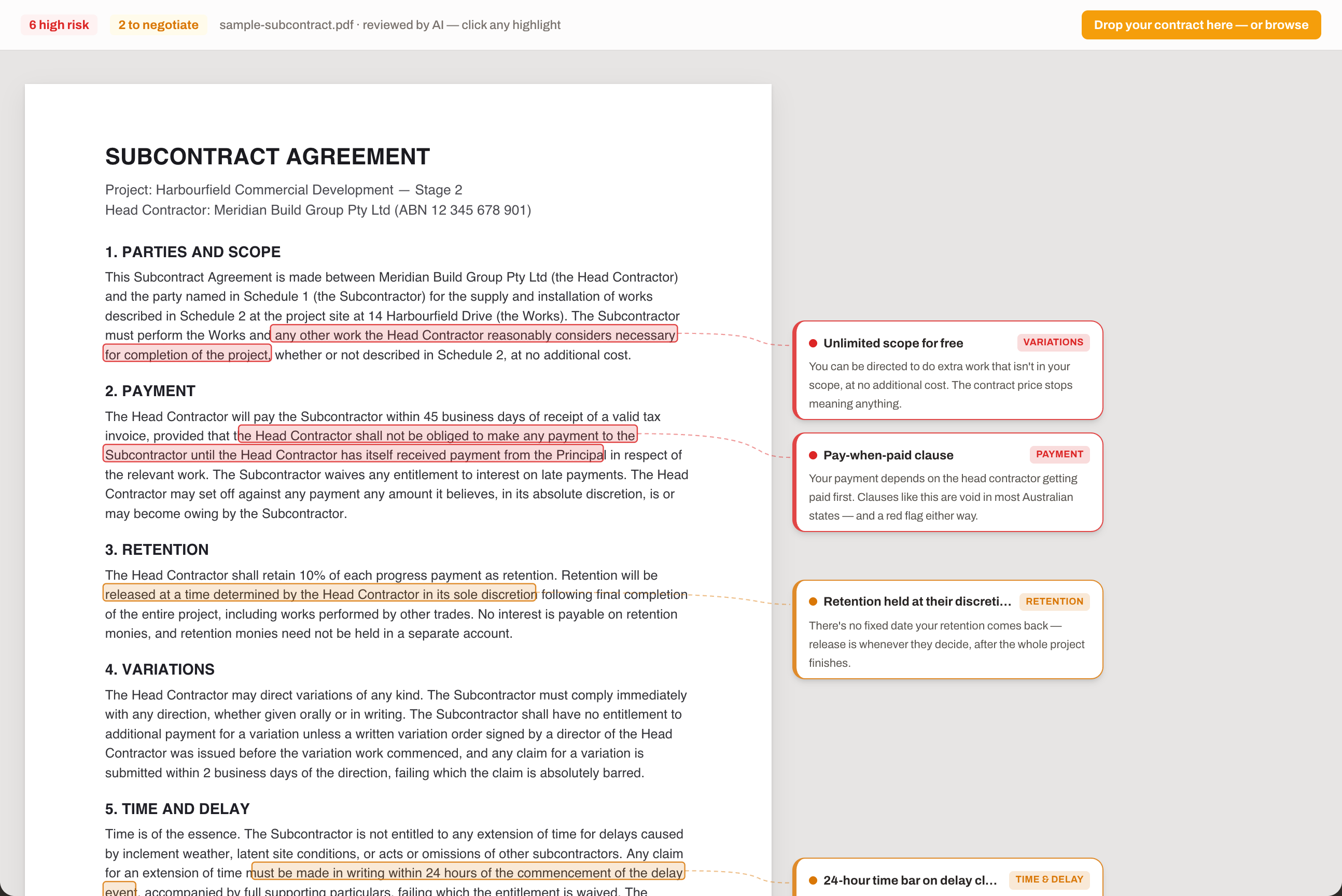
A reviewed construction subcontract in ContractorCounter Review: risky clauses highlighted on the page with margin callouts for pay-when-paid, uncapped liquidated damages, and retention terms
The AI reads your contract before you pay — see a fully reviewed sample free
  • Own-negligence carve-out check
  • Insurability red flags
  • Mutuality and cap asks
  • AI flags indemnity traps for $19

What an indemnity actually does

It converts a claim someone would have to prove against you into a debt you agreed to pay — often bypassing the defences, proportionate-liability rules, and damage limits that would otherwise protect you. That's why indemnities are drafted broadly by the receiving side: the clause is worth more than the underlying legal claim it replaces.

The wording that should stop you

'Howsoever arising', 'whether or not caused by negligence', indemnities with no carve-out for the indemnified party's own negligence or wilful misconduct, and indemnities covering 'any breach of this contract' (which turns every minor breach into an indemnified debt). Also watch scope creep: indemnifying the principal and the head contractor and their consultants extends your promise to parties you have no contract with.

The insurability test

Public liability policies commonly exclude or limit liability assumed under contract beyond what the law would impose anyway. That means the broadest indemnities are precisely the least insured — you're granting cover your insurer refused to write. Before signing, send the indemnity and insurance clauses to your broker together; if the broker winces, negotiate. The same review should confirm the insurance clause only asks for cover you actually hold.

What to ask for

Mutuality (they indemnify you on the same terms), a carve-out reducing the indemnity to the extent the loss was caused by the indemnified party's negligence, a cap tied to your insurance limits, and scope confined to third-party personal injury and property damage from your own works. These are standard asks a reasonable counterparty accepts — and the refusals tell you what they expect the clause to do. A full review reads the indemnity beside the LD and insurance clauses, where the combined exposure actually lives.

Common questions

Short answers for contractors

What is a one-sided indemnity clause?

An indemnity that runs in only one direction — you cover their losses, they don't cover yours — and typically extends beyond your fault: losses 'howsoever arising', or expressly including those caused by the indemnified party's own negligence. The one-sidedness compounds: broad indemnity, no cap, no mutual obligation, and an insurance clause that doesn't actually respond to the promise you just made.

Why do insurers dislike broad indemnity clauses?

Because liability policies are priced for what the law would make you pay, and a broad contractual indemnity makes you pay more than that — policies commonly exclude or restrict liability assumed under contract beyond your legal liability. The practical consequence: the wider the indemnity you sign, the larger the uninsured gap you personally carry. Always read the indemnity clause and your policy's contractual-liability wording together, ideally with your broker, before signing.

What indemnity terms should a subcontractor accept?

A reasonable baseline: indemnity limited to third-party personal injury and property damage arising from your own works and your own negligence; reduced proportionally to the extent the other party contributed; mutual where exposure runs both ways; and capped in line with your insurance program. That protects the counterparty against the risk you genuinely create without making you the project's unpaid insurer.

How much does an AI construction contract review cost?

ContractorCounter Review costs a flat US$19 per contract, whatever the page count — no subscription, no account, no demo call. The AI reads the contract and shows you what it found (how many issues, how severe, on which pages) before you pay anything; the $19 unlocks the full marked-up review with every clause highlighted and a plain-English concern and negotiation ask for each.

Is my contract kept private?

The contract PDF never leaves your browser — only its extracted text is processed to produce the review, and it is not used to train AI models. Findings are stored temporarily to deliver your purchase (7 days unpurchased, 30 days after unlock) and then deleted automatically.

Is this legal advice?

No. ContractorCounter Review is an AI-powered first-pass review that flags risky, one-sided, and ambiguous clauses so you know exactly what to question. It is not a law firm and its output is not legal advice — for contracts worth serious money, take the marked-up review to a construction lawyer and spend their billable hours on judgment instead of reading.

Get your first takeoff done in minutes

Open a plan set, mark it up, and take quantities off the sheet — in your browser, on any device, with nothing to install.

Start free trial

14-day free trial · No credit card required