US payment rights

US Payment Rights: Pay-If-Paid, Prompt Payment & Liens

US subcontractors are protected by a patchwork, not a single law: the federal Prompt Payment Act and Miller Act on federal jobs, and state prompt-payment acts, mechanics lien statutes, and Little Miller Acts everywhere else. The patchwork matters because the answer to 'is this clause enforceable?' — especially pay-if-paid — genuinely changes at the state line.

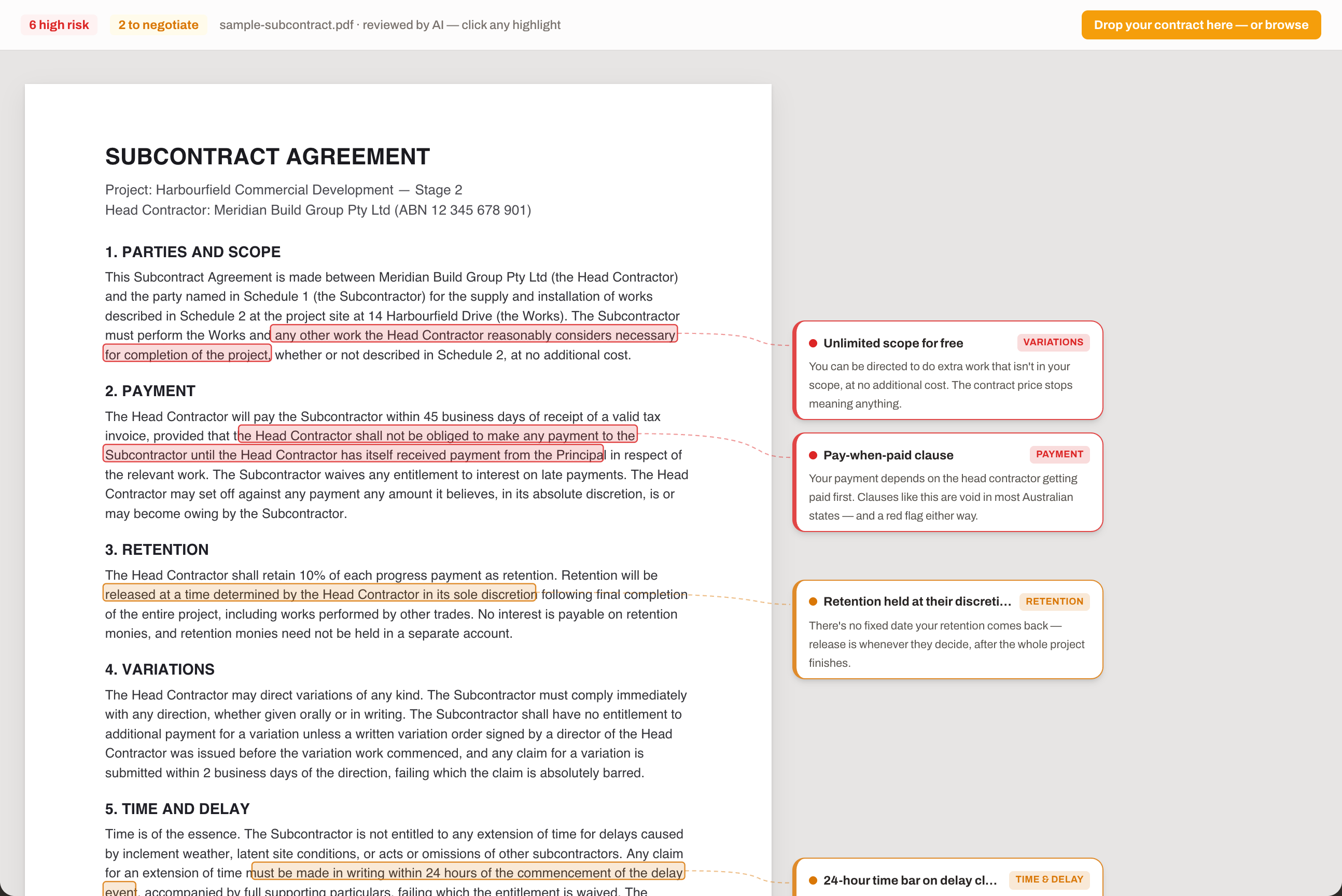
A reviewed construction subcontract in ContractorCounter Review: risky clauses highlighted on the page with margin callouts for pay-when-paid, uncapped liquidated damages, and retention terms
The AI reads your contract before you pay — see a fully reviewed sample free
  • Federal 14/7-day payment clocks
  • Pay-if-paid status by key state
  • Miller Act and lien deadlines
  • Waiver clauses flagged for $19

Federal jobs: fixed clocks and bonded payment

On federal construction, the Prompt Payment Act (31 U.S.C. §3901 et seq.) requires the government to pay the prime within 14 days of a proper payment request, and the prime to pay subs within 7 days of receiving payment — with interest, and the obligation flows down every tier (FAR 52.232-27). The Miller Act (40 U.S.C. §§3131–3134) requires payment bonds on federal work over $100,000: unpaid subs claim on the bond, with second-tier claimants giving written notice within 90 days of last work and suing within one year.

Pay-if-paid: the state-by-state question

A pay-if-paid clause makes owner payment a condition of yours. California voided them in 1997 (Wm. R. Clarke v. Safeco — they impermissibly waive lien rights), New York holds them against public policy (West-Fair v. Aetna), Virginia banned conditioning payment on owner receipt for contracts from 2023, and Delaware voids them on private work. In Illinois they're no defense to lien and bond claims, though not banned outright. In a majority of other states, clear 'condition precedent' wording is enforced — so never assume; check your state before signing.

State prompt payment and lien rights

Most states run prompt-payment acts with interest penalties — Texas, for example, requires owners to pay within 35 days of an invoice with a 7-day cascade down the chain, 1.5% monthly interest, attorney fees, and a right to suspend work after notice. Mechanics liens secure payment against the property itself, and some states protect them hard: California voids any advance lien waiver (Civil Code §8122) — only its statutory release forms, signed as payment actually flows, are effective.

What contracts try anyway

Pay-if-paid conditions in states where they're void, advance lien waivers, lien releases demanded before payment rather than against it, short claim time bars, and payment periods longer than the state act allows. A contract review flags each of these so you know which clauses to strike and which state rights survive whatever you sign.

Common questions

Short answers for contractors

Is pay-if-paid enforceable in the US?

It depends on the state. California, New York, Virginia (contracts from January 2023), and Delaware (private work) treat pay-if-paid conditions as void; Illinois bars them as a defense to lien and bond claims while leaving contract claims intact; and a majority of states enforce them where the wording clearly creates a condition precedent. Ambiguous wording is generally construed as pay-when-paid — a timing clause only. Check your state's position before signing, not after the owner stops paying.

What payment rights do subcontractors have on US federal projects?

Two strong ones. The Prompt Payment Act clocks: the government pays the prime within 14 days of a proper request, the prime pays subs within 7 days of receipt, interest accrues automatically, and the terms flow down every tier. And Miller Act bonds: federal work over $100,000 carries a payment bond you can claim against — with a 90-day notice deadline for second-tier claimants and a one-year suit limit, so diarise both the moment your work ends.

Can a contract waive my mechanics lien rights?

In California, no — Civil Code §8122 voids advance waivers, and only the statutory release forms exchanged as payment flows are effective. Other states vary, and conditional-versus-unconditional release games are a classic trap everywhere: never hand over an unconditional release for a payment you haven't received. Have every waiver request checked against what your state actually permits.

How much does an AI construction contract review cost?

ContractorCounter Review costs a flat US$19 per contract, whatever the page count — no subscription, no account, no demo call. The AI reads the contract and shows you what it found (how many issues, how severe, on which pages) before you pay anything; the $19 unlocks the full marked-up review with every clause highlighted and a plain-English concern and negotiation ask for each.

Is my contract kept private?

The contract PDF never leaves your browser — only its extracted text is processed to produce the review, and it is not used to train AI models. Findings are stored temporarily to deliver your purchase (7 days unpurchased, 30 days after unlock) and then deleted automatically.

Is this legal advice?

No. ContractorCounter Review is an AI-powered first-pass review that flags risky, one-sided, and ambiguous clauses so you know exactly what to question. It is not a law firm and its output is not legal advice — for contracts worth serious money, take the marked-up review to a construction lawyer and spend their billable hours on judgment instead of reading.

Get your first takeoff done in minutes

Open a plan set, mark it up, and take quantities off the sheet — in your browser, on any device, with nothing to install.

Start free trial

14-day free trial · No credit card required