QLD Security of Payment

QLD Security of Payment (BIF Act): Subbie's Contract Guide

Queensland's Building Industry Fairness (Security of Payment) Act 2017 backs subcontractor payment with the country's sharpest teeth: failing to serve a payment schedule is not just a liability — it's an offence. Section 200 voids contract provisions that try to exclude or water down the Act, and payment terms are capped by statute regardless of what the subcontract says.

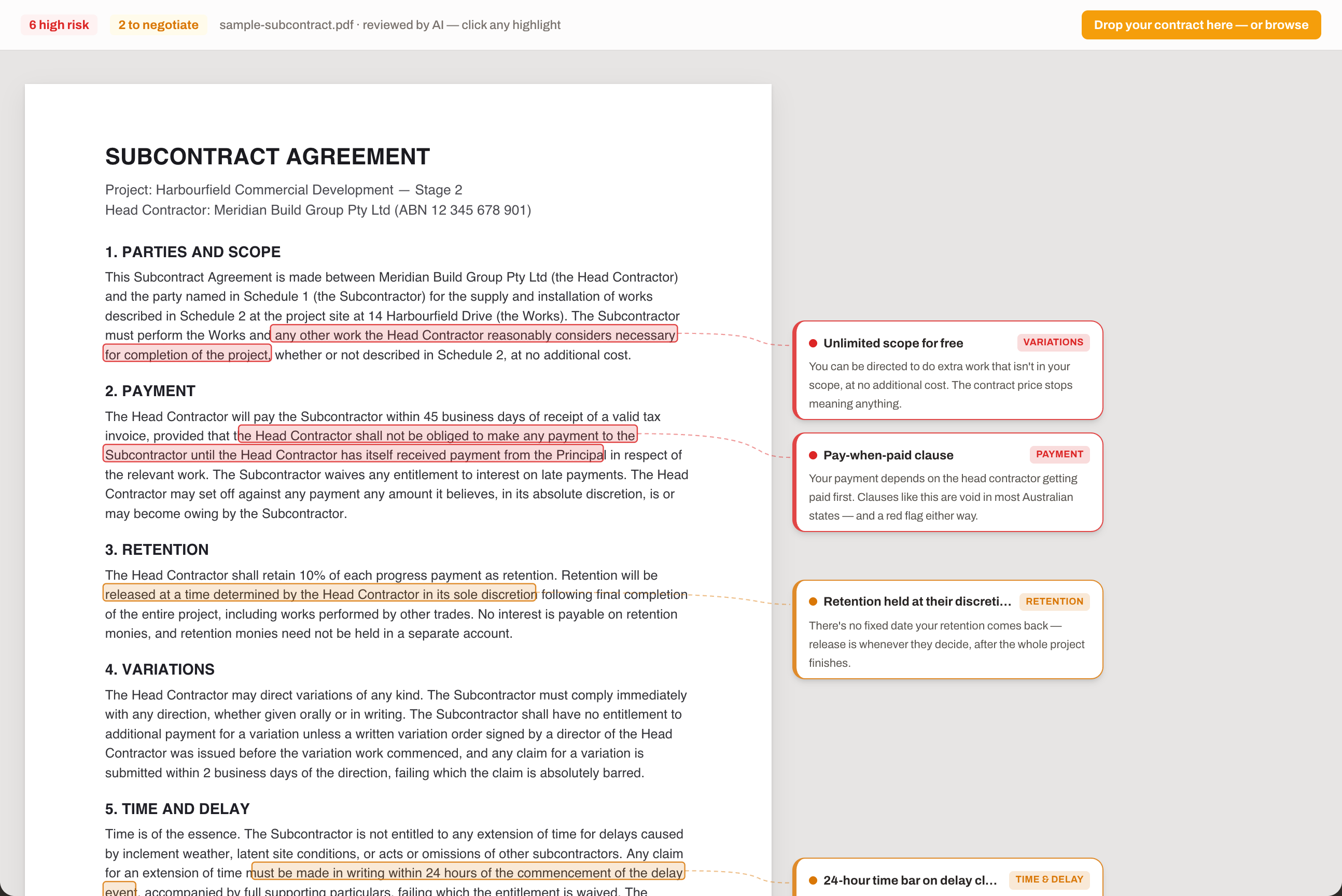
A reviewed construction subcontract in ContractorCounter Review: risky clauses highlighted on the page with margin callouts for pay-when-paid, uncapped liquidated damages, and retention terms
The AI reads your contract before you pay — see a fully reviewed sample free
  • No payment schedule = an offence
  • 25-business-day cap on subbie terms
  • Adjudication paid in 5 business days
  • s 200 voids contracting-out

What the BIF Act guarantees

Progress claims from each reference date (QLD kept reference dates: the contract date, or the last day of each month by default). An invoice counts as a claim. The respondent has 15 business days to serve a payment schedule — failing to is an offence carrying up to 100 penalty units — and without one becomes liable for the full claimed amount. Adjudicated amounts must be paid within 5 business days of the decision.

Payment terms are capped by statute

Default due date is 10 business days after the claim. The hard caps sit in the QBCC Act 1991: subcontract terms allowing payment later than 25 business days are void (s 67U), and commercial head-contract terms beyond 15 business days are void (s 67W). Pay-when-paid provisions have no effect at all (BIF Act s 74) — a contract containing one is treated as having no due date, so the 10-day default applies.

Trust accounts on bigger jobs

QLD runs project and retention trust accounts: project trusts on eligible Queensland Government contracts from $1 million and private-sector contracts from $10 million, with retention money held in trust where the framework applies. The further rollout below $10 million was paused in early 2025 — check current QBCC thresholds for your contract before relying on trust protection.

What contracts still try

Claim preconditions (statutory declarations, insurance certificates as a condition of a valid claim) fall foul of s 200, as do clauses fixing claim dates to defeat the Act's timing. Payment terms beyond the caps are void. What survives: time bars on contractual claims, uncapped LDs, and one-sided indemnities — the Act protects the payment pipe, not the commercial terms. Review both before signing.

Common questions

Short answers for contractors

How long can a QLD subcontract make me wait for payment?

No longer than 25 business days after the payment claim — the QBCC Act voids subcontract provisions beyond that (s 67U), and commercial head contracts are capped at 15 business days (s 67W). If the contract is silent, the BIF Act default of 10 business days applies, and a pay-when-paid clause doesn't move the date because it has no effect (s 74).

What if the head contractor ignores my payment claim in QLD?

Two things happen. They become liable for the full claimed amount (s 77(2)) — recoverable as a debt after a warning notice, or through adjudication — and they've committed an offence, because serving a payment schedule within 15 business days is mandatory, with up to 100 penalty units and QBCC disciplinary exposure attached. QLD is the one state where silence on a claim is itself unlawful.

Do QLD trust accounts protect my retention?

Where the framework applies, yes — retention withheld under a project that has a project trust must be held in a retention trust account rather than the head contractor's general funds. Coverage currently depends on the project: government contracts from $1 million and private contracts from $10 million, with the broader rollout paused in early 2025. Confirm the current QBCC thresholds for your specific contract rather than assuming trust protection.

How much does an AI construction contract review cost?

ContractorCounter Review costs a flat US$19 per contract, whatever the page count — no subscription, no account, no demo call. The AI reads the contract and shows you what it found (how many issues, how severe, on which pages) before you pay anything; the $19 unlocks the full marked-up review with every clause highlighted and a plain-English concern and negotiation ask for each.

Is my contract kept private?

The contract PDF never leaves your browser — only its extracted text is processed to produce the review, and it is not used to train AI models. Findings are stored temporarily to deliver your purchase (7 days unpurchased, 30 days after unlock) and then deleted automatically.

Is this legal advice?

No. ContractorCounter Review is an AI-powered first-pass review that flags risky, one-sided, and ambiguous clauses so you know exactly what to question. It is not a law firm and its output is not legal advice — for contracts worth serious money, take the marked-up review to a construction lawyer and spend their billable hours on judgment instead of reading.

Get your first takeoff done in minutes

Open a plan set, mark it up, and take quantities off the sheet — in your browser, on any device, with nothing to install.

Start free trial

14-day free trial · No credit card required