VIC Security of Payment

VIC Security of Payment: The 2026 Reforms Changed Everything

Victoria's Security of Payment Act was the weakest in Australia — until the Fairer Payments on Jobsites reforms commenced on 15 April 2026. Reference dates are gone, the notorious excluded-amounts regime is repealed, payment terms are capped at 20 business days, and notice-based time bars can now be declared unfair and unenforceable. Advice written before 2026 is out of date, and so are the contracts that relied on the old Act.

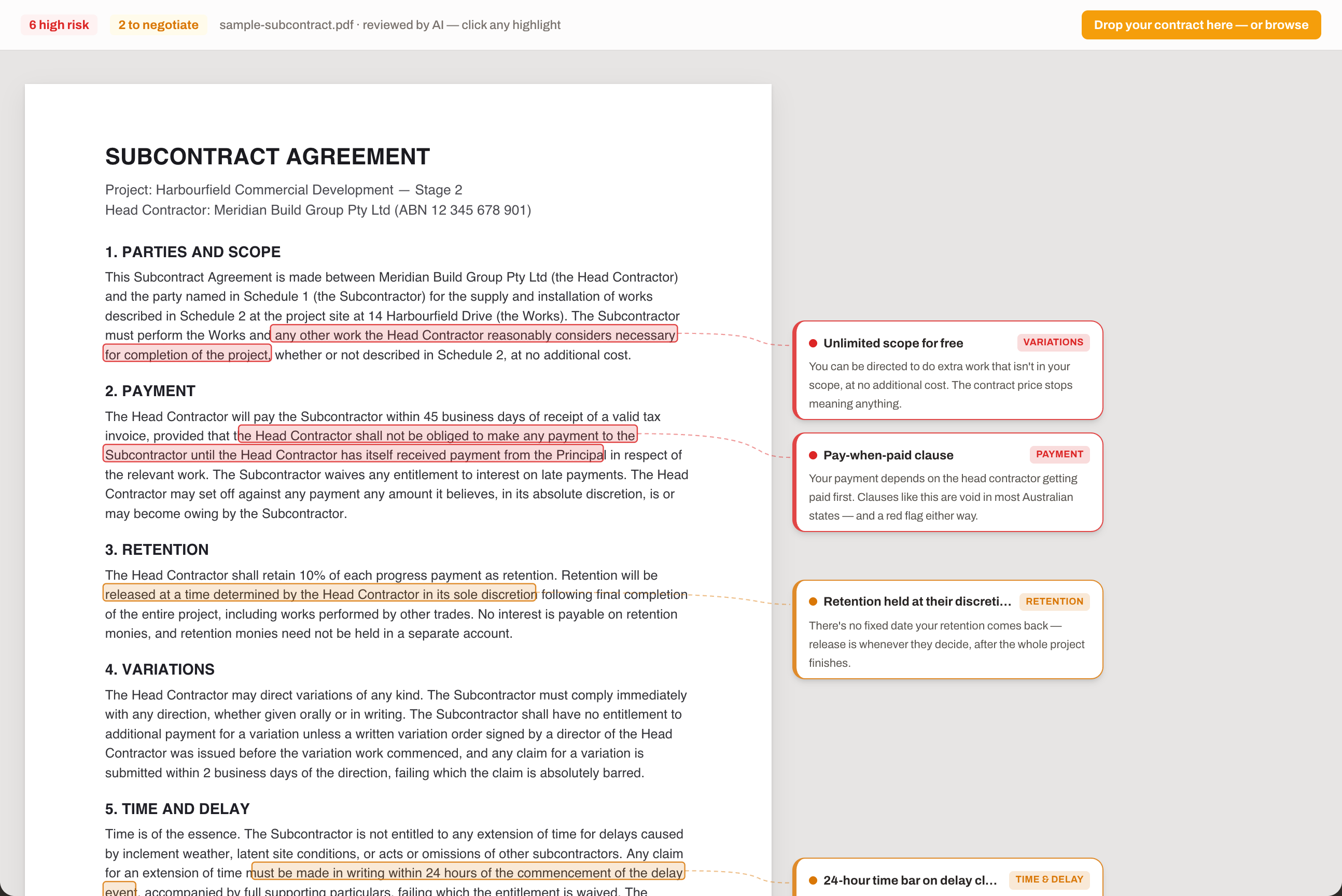
A reviewed construction subcontract in ContractorCounter Review: risky clauses highlighted on the page with margin callouts for pay-when-paid, uncapped liquidated damages, and retention terms
The AI reads your contract before you pay — see a fully reviewed sample free
  • Monthly claims — reference dates gone
  • Excluded amounts repealed
  • 20-business-day payment cap
  • Unfair time bars voidable (s 13A)

What changed in April 2026

Claims now arise monthly by right (s 14A) — clauses restricting when or how often you claim have no effect (s 14B), and the window after practical completion doubled to 6 months. The excluded-amounts regime (old ss 10A–10B) is repealed: variations, latent conditions, and time-related costs are claimable through the Act like anywhere else. And payment terms beyond 20 business days after a claim now have no effect (s 12(1B)).

The engine underneath

Serve a claim stating it's under the Act; the respondent has 10 business days to serve a payment schedule; no schedule means liability for the full claimed amount, recoverable as a debt with defences barred (s 16(4)) or through adjudication. Pay-when-paid has no effect (s 13), and s 48 voids any provision that excludes, modifies, or restricts the Act or deters you from using it.

Unfair time bars can now be struck

New s 13A — modelled on WA's mechanism — lets an adjudicator, court, arbitrator, or expert declare a notice-based time bar unfair, and of no effect for that entitlement, where compliance wasn't reasonably possible or would be unreasonably onerous. It covers payment, EOT, and security-release notices. It's a shield, not a licence: notice discipline still wins claims; s 13A rescues the deserving cases that miss impossible windows.

Performance security and what to review

The reforms added statutory rights to claim release of performance security — retention and bank guarantees — through the Act's machinery (ss 17A–17H). What the Act still doesn't touch: LD rates and caps, indemnities, scope, and termination. Contracts drafted for old-VIC conditions are full of now-void clauses next to still-enforceable ones; a $19 review tells you which is which.

Common questions

Short answers for contractors

What did Victoria's 2026 Security of Payment reforms change?

The Building Legislation Amendment (Fairer Payments on Jobsites and Other Matters) Act 2025 commenced 15 April 2026 and rebuilt the regime: monthly payment claims replace reference dates (with clauses restricting claim timing void), the excluded-amounts regime is repealed so variations and time-related costs are claimable, payment terms beyond 20 business days have no effect, notice-based time bars can be declared unfair, and there's a new statutory path to claim release of retention and bank guarantees. It applies to existing contracts, but not to claims served before commencement.

Can I claim variations under the VIC Act now?

Yes. The old excluded-amounts regime (ss 10A–10B) — which kept most disputed variations, latent conditions, and time-related costs out of adjudication and made Victoria the outlier state — was repealed effective 15 April 2026. Claimable amounts now work the way they do in the rest of Australia, which transforms how much of a real progress claim the Act can actually enforce.

Are time bars enforceable in Victoria after the reforms?

By default yes, but with a new safety valve: s 13A allows an adjudicator, court, arbitrator, or expert to declare a notice-based time bar unfair — and of no effect for that entitlement — where complying wasn't reasonably possible or would be unreasonably onerous, with the onus on the party alleging unfairness. Don't rely on it as a strategy: serve notices on time, and treat s 13A as the backstop for genuinely impossible windows.

How much does an AI construction contract review cost?

ContractorCounter Review costs a flat US$19 per contract, whatever the page count — no subscription, no account, no demo call. The AI reads the contract and shows you what it found (how many issues, how severe, on which pages) before you pay anything; the $19 unlocks the full marked-up review with every clause highlighted and a plain-English concern and negotiation ask for each.

Is my contract kept private?

The contract PDF never leaves your browser — only its extracted text is processed to produce the review, and it is not used to train AI models. Findings are stored temporarily to deliver your purchase (7 days unpurchased, 30 days after unlock) and then deleted automatically.

Is this legal advice?

No. ContractorCounter Review is an AI-powered first-pass review that flags risky, one-sided, and ambiguous clauses so you know exactly what to question. It is not a law firm and its output is not legal advice — for contracts worth serious money, take the marked-up review to a construction lawyer and spend their billable hours on judgment instead of reading.

Get your first takeoff done in minutes

Open a plan set, mark it up, and take quantities off the sheet — in your browser, on any device, with nothing to install.

Start free trial

14-day free trial · No credit card required