UK Construction Act

UK Construction Act: Payment Notices & Adjudication

The Housing Grants, Construction and Regeneration Act 1996 — the Construction Act — gives every party to a UK construction contract rights no contract can remove: staged payments, a notice regime where the notified sum must be paid, a ban on pay-when-paid, the right to suspend for non-payment, and adjudication of any dispute at any time. Where contract terms fall short, the Scheme for Construction Contracts is written in over them.

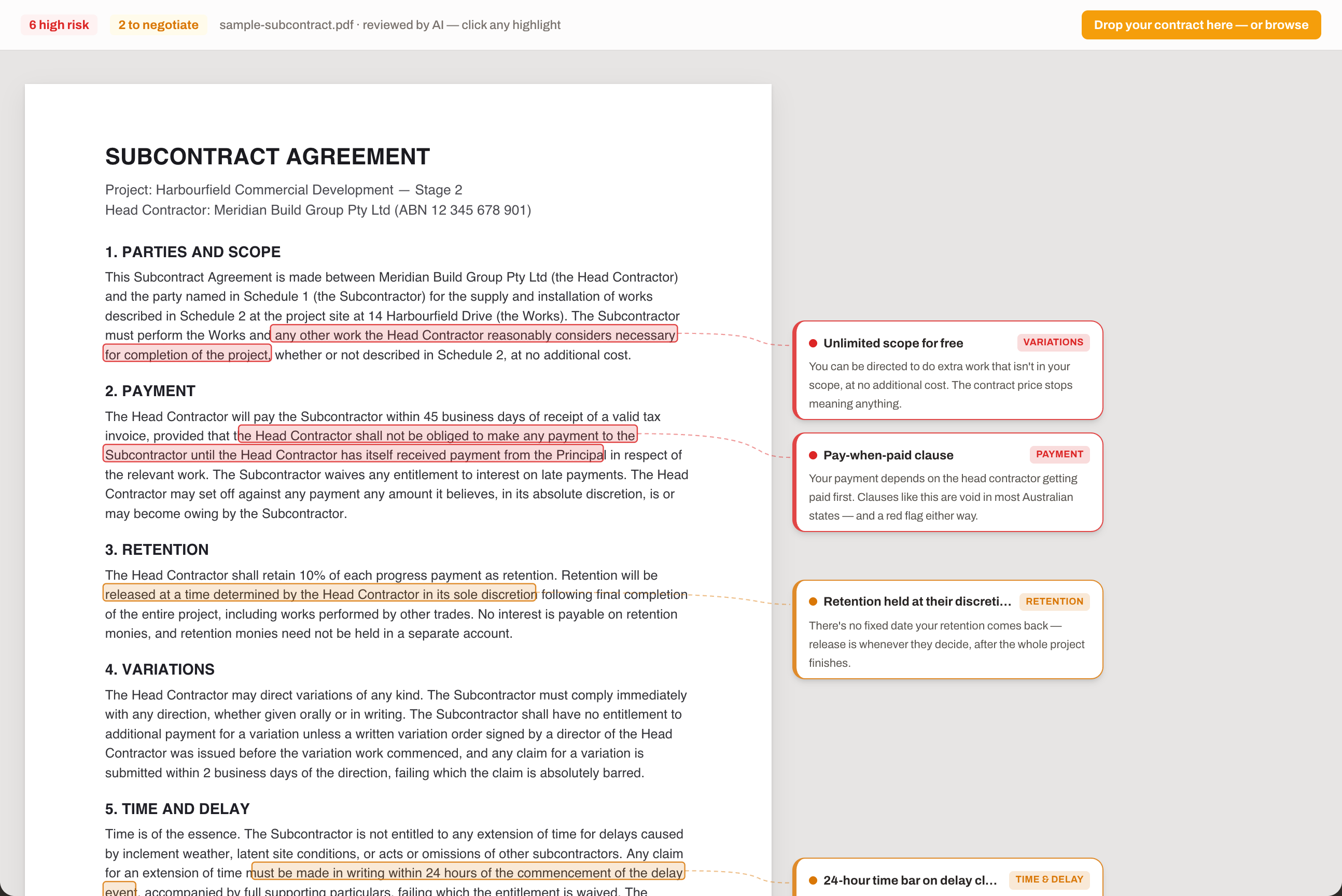
A reviewed construction subcontract in ContractorCounter Review: risky clauses highlighted on the page with margin callouts for pay-when-paid, uncapped liquidated damages, and retention terms
The AI reads your contract before you pay — see a fully reviewed sample free
  • s 111: the notified sum must be paid
  • s 113 pay-when-paid ban explained
  • Suspension rights with costs
  • Adjudication at any time

The notice regime is the whole game

The payer must give a payment notice within 5 days of the due date stating the sum it considers due and how it's calculated (s 110A) — and must pay that notified sum by the final date for payment unless it serves a valid pay less notice in time (s 111). Miss the notices, pay the claim: if the payer gives no notice, the payee's application can stand as the notified sum (s 110B). This is why 'smash and grab' adjudications work — and why your own applications must be complete, on time, and clearly calculated.

Pay-when-paid is dead (with one exception)

Section 113 makes any provision conditioning payment on the payer receiving money from a third party ineffective, unless that third party is insolvent. The 2009 amendments closed the workarounds: conditioning payment on certification or performance under another contract is an inadequate payment mechanism (s 110(1A)), and the Scheme's terms replace it. If your subcontract still carries pay-when-paid wording, it's unenforceable — but strike it anyway.

Suspension and adjudication

Unpaid after the final date with no valid pay less notice? After 7 days' written notice you may suspend some or all of your obligations, recover the costs of the suspension, and the delay doesn't count against your program (s 112). Any dispute can go to adjudication 'at any time' (s 108): a 28-day decision, binding until finally determined — the fastest payment-enforcement tool in UK construction.

What contracts still try

Conditions dressed as process — payment applications valid only on specific forms by specific dates, certification preconditions, cross-contract set-off — plus tight time bars on claims, retention release tied to the head contract, and cost-shifting clauses aimed at making adjudication uneconomic (constrained by s 108A). The Act replaces non-compliant payment terms, but only if you spot the games and run your notices properly. A $19 review maps every notice obligation before you sign.

Common questions

Short answers for contractors

What happens if the payer doesn't serve a payment notice or pay less notice?

The sum applied for becomes the notified sum, and it must be paid by the final date for payment — the payer has lost the right to argue the valuation for that cycle and can only pay now, argue later. This is the mechanism behind smash-and-grab adjudications, and it cuts both ways: your payment applications need to be complete, on time, and calculated clearly enough to stand as a default notice (s 110B).

Does the Construction Act apply to my contract?

It applies to construction operations in England, Wales, and Scotland, including oral and partly oral contracts since the 2011 amendments — you don't need Act-compliant wording in the contract, because where terms don't comply, the Scheme for Construction Contracts applies instead. Some sectors and residential-occupier work sit outside the Act; Northern Ireland runs its own parallel legislation.

Can I suspend work for non-payment in the UK?

Yes — it's a statutory right, not a breach. If the notified sum isn't paid in full by the final date and no valid pay less notice was served, you may suspend any or all of your obligations after giving at least 7 days' written notice stating the ground. You're entitled to a reasonable amount for costs and expenses of the suspension, and the suspension period doesn't count against your completion obligations.

How much does an AI construction contract review cost?

ContractorCounter Review costs a flat US$19 per contract, whatever the page count — no subscription, no account, no demo call. The AI reads the contract and shows you what it found (how many issues, how severe, on which pages) before you pay anything; the $19 unlocks the full marked-up review with every clause highlighted and a plain-English concern and negotiation ask for each.

Is my contract kept private?

The contract PDF never leaves your browser — only its extracted text is processed to produce the review, and it is not used to train AI models. Findings are stored temporarily to deliver your purchase (7 days unpurchased, 30 days after unlock) and then deleted automatically.

Is this legal advice?

No. ContractorCounter Review is an AI-powered first-pass review that flags risky, one-sided, and ambiguous clauses so you know exactly what to question. It is not a law firm and its output is not legal advice — for contracts worth serious money, take the marked-up review to a construction lawyer and spend their billable hours on judgment instead of reading.

Get your first takeoff done in minutes

Open a plan set, mark it up, and take quantities off the sheet — in your browser, on any device, with nothing to install.

Start free trial

14-day free trial · No credit card required