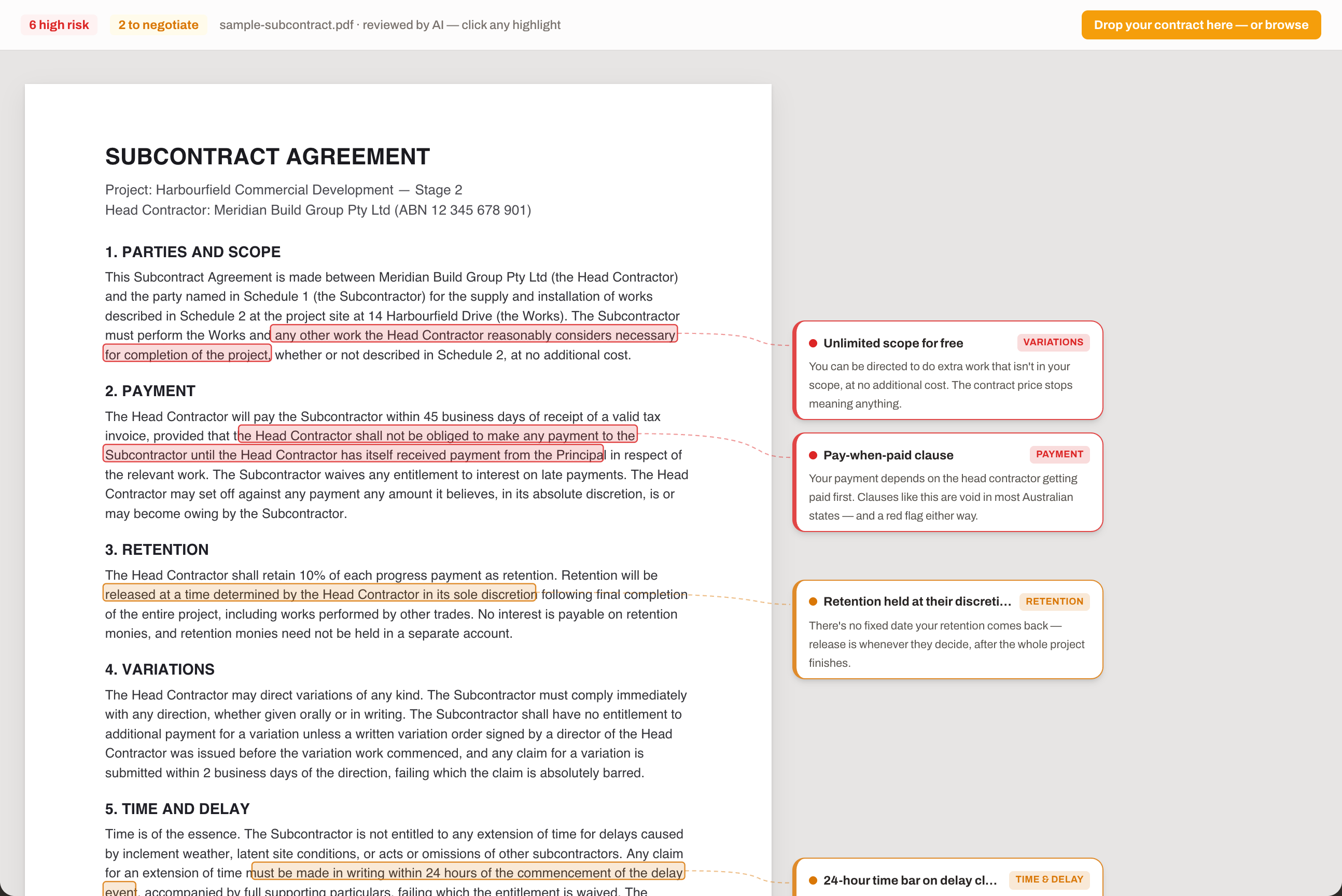
Florida payment rights

Pay-If-Paid in Florida: Enforceable, and Everywhere

Florida enforces pay-if-paid clauses. Under Peacock Construction v. Modern Air Conditioning (1977), a 'payment by owner' clause is presumed to just set a reasonable time to pay — unless the wording unambiguously shifts the risk of owner nonpayment onto the subcontractor, in which case it does exactly that. Whether your subcontract has the magic words is a question you want answered before you sign, not when the owner stops paying.

A reviewed construction subcontract in ContractorCounter Review: risky clauses highlighted on the page with margin callouts for pay-when-paid, uncapped liquidated damages, and retention terms
The AI reads your contract before you pay — see a fully reviewed sample free
  • Pay-if-paid enforceable — caught pre-signature
  • 45-day Notice to Owner or no lien
  • Signed non-statutory waivers are binding
  • Every risky clause flagged for $19

The magic-words test

Florida's rule splits on drafting precision. Ambiguous clauses are construed as pay-when-paid — a timing provision that still obliges the contractor to pay you within a reasonable time (Peacock, 1977; DEC Electric v. Raphael Construction, 1990, which made the interpretation a question of law). But a clause that clearly makes owner payment a condition precedent to yours transfers the owner-insolvency risk to you, and Florida courts enforce it. The difference between the two can be a single sentence of condition-precedent language buried in the payment article.

The 45-day Notice to Owner — miss it, lose the lien

A subcontractor without a direct contract with the owner must serve a Notice to Owner before starting or within 45 days of first furnishing labor or materials — failure to serve it, or to serve it on time, is 'a complete defense' to enforcing your lien (§713.06). The claim of lien itself must be recorded within 90 days of final furnishing (§713.08), the lien lasts one year unless suit is filed, and the owner can compress that to 60 days by recording a Notice of Contest (§713.22). These are the notice traps that quietly decide whether nonpayment is your problem or your leverage.

Prompt payment: weaker than it sounds on private work

Florida's private prompt-payment law (§715.12) sets no fixed payment deadline — payment falls due per your contract's own terms, after a written request and any required waivers, and for anyone below the owner the statute itself conditions the duty to pay on having been paid from above. What it does give you: once payment is 14 days overdue, interest runs at the judgment rate plus 12% per year, and you can't be made to waive that interest before payment is due. Public work is a different story — local governments pay in 20–25 business days, state entities within 20, with 10-day and 7-day pass-throughs down the chain and 2% monthly interest on state work (§§218.735, 255.073).

Lien waivers: read what you sign

Florida bans waiving lien rights in advance and provides statutory waiver forms — but unlike California or Texas, the forms are not mandatory: a non-statutory waiver you voluntarily sign is enforceable according to its terms (§713.20). You can't be required to use a form that differs from the statute as a condition of payment, yet a broad release slipped into a payment package and signed is binding. On public jobs, retainage is capped at 5% per progress payment (§§218.735, 255.078). The $19 review reads the payment article, the release forms, and the condition-precedent wording before your signature makes them real — see also your nationwide payment rights.

Common questions

Short answers for contractors

Is pay-if-paid enforceable in Florida?

Yes, when it's unambiguous. Under Peacock Construction v. Modern Air Conditioning (Fla. 1977), a payment-by-owner clause is presumed to set only a reasonable time for payment — but wording that clearly makes owner payment a condition precedent shifts the insolvency risk to the subcontractor and will be enforced. DEC Electric v. Raphael Construction (Fla. 1990) made this a question of law: ambiguity means pay-when-paid, clarity means you carry the owner's credit risk. Check which one your draft contains before signing.

What is the Notice to Owner deadline in Florida?

Serve it before commencing work or within 45 days of first furnishing labor or materials (§713.06) — it's a prerequisite to perfecting a lien for anyone not in direct contract with the owner, and the statute calls untimely service 'a complete defense' to enforcement. Then record any claim of lien within 90 days of final furnishing (§713.08). Diarise both dates on day one; they don't extend because negotiations are ongoing.

Does Florida have a prompt payment law for private construction?

Yes, but it's weaker than most states': §715.12 sets no fixed day count — payment falls due under your contract's own terms after a proper written request, and the statute conditions a non-owner payor's obligation on being paid from above. Its teeth are interest (judgment rate plus 12% per year from the 14th day overdue, unwaivable in advance) rather than a deadline. Public work is stricter: 20–25 business day clocks with 10- and 7-day pass-throughs down the chain.

How much does an AI construction contract review cost?

ContractorCounter Review costs a flat US$19 per contract, whatever the page count — no subscription, no account, no demo call. The AI reads the contract and shows you what it found (how many issues, how severe, on which pages) before you pay anything; the $19 unlocks the full marked-up review with every clause highlighted and a plain-English concern and negotiation ask for each.

Is my contract kept private?

The contract PDF never leaves your browser — only its extracted text is processed to produce the review, and it is not used to train AI models. Findings are stored temporarily to deliver your purchase (7 days unpurchased, 30 days after unlock) and then deleted automatically.

Is this legal advice?

No. ContractorCounter Review is an AI-powered first-pass review that flags risky, one-sided, and ambiguous clauses so you know exactly what to question. It is not a law firm and its output is not legal advice — for contracts worth serious money, take the marked-up review to a construction lawyer and spend their billable hours on judgment instead of reading.

Get your first takeoff done in minutes

Open a plan set, mark it up, and take quantities off the sheet — in your browser, on any device, with nothing to install.

Start free trial

14-day free trial · No credit card required