New York payment rights

Pay-If-Paid Is Void in New York — and the Act Has Teeth

New York's Court of Appeals held in West-Fair Electric v. Aetna (1995) that pay-if-paid clauses are void as against public policy: forcing a subcontractor to carry the owner's insolvency risk amounts to waiving lien rights, which Lien Law §34 forbids. And uniquely among US states, New York's private-work Prompt Payment Act makes its core payment rules mandatory — clauses that contradict them are simply void.

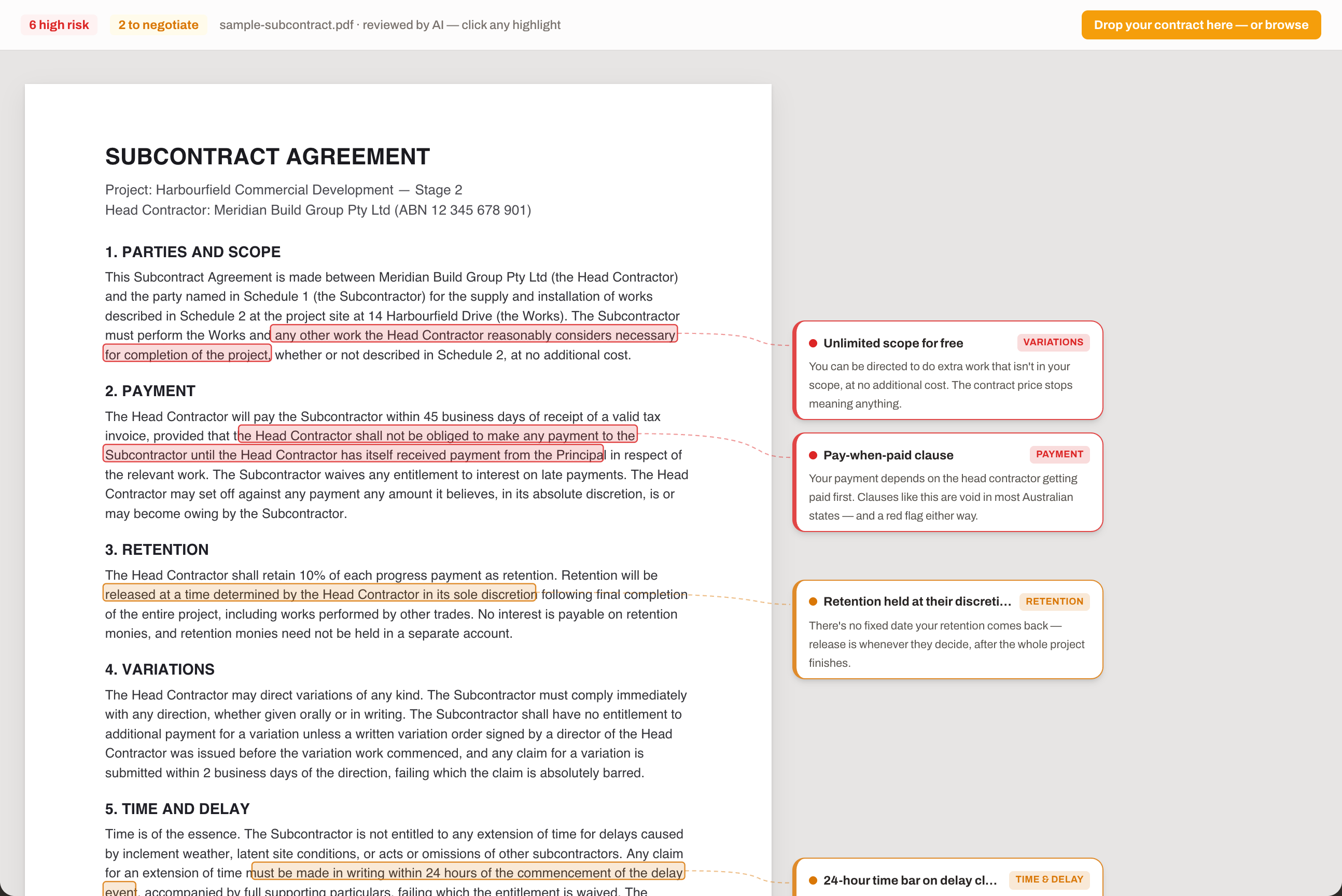
A reviewed construction subcontract in ContractorCounter Review: risky clauses highlighted on the page with margin callouts for pay-when-paid, uncapped liquidated damages, and retention terms
The AI reads your contract before you pay — see a fully reviewed sample free
  • Pay-if-paid void since West-Fair (1995)
  • 30/7-day clocks mandatory on covered jobs
  • 5% retainage cap, 30-day release
  • Out-of-state law clauses void — flagged for $19

Pay-if-paid and lien waivers: both void

West-Fair ties the pay-if-paid question to lien rights: because a true condition-precedent payment clause would waive your right to lien, and §34 voids any agreement waiving lien rights, the clause cannot survive. The same section kills advance lien waivers outright. Your lien window is generous by US standards — file within 8 months of last furnishing (4 months on a single-family dwelling, Lien Law §10) — which makes New York one of the few states where the statute, not the calendar, is your main protection.

The Prompt Payment Act rules you can't sign away

On covered private contracts — aggregate project cost of $150,000 or more, excluding small residential work, projects of 4,500 square feet or less, and all public contracts — General Business Law article 35-E sets the machine: invoices approved within 12 business days, the owner pays within 30 days of approval, and everyone downstream pays within 7 days of receiving funds (§756-a), with 1% monthly interest and a right to suspend work after 10 days' written notice of unpaid undisputed amounts (§756-b). Billing-cycle and due-date mechanics stay contract-led, but §757 does what most states don't: it voids provisions that deviate from the payment and interest rules, bar suspension, block expedited arbitration — or impose another state's law or an out-of-state venue. That last one matters: the choice-of-law games that revive pay-if-paid elsewhere are void here on covered jobs.

Retainage: capped at 5%, released in 30 days

For covered private contracts signed since 17 November 2023, retainage is capped at 5% of the contract sum at every tier and must be released within 30 days of final approval of the work (§§756-c, 757) — and the contractor may submit its final invoice at substantial completion (§756-a). For contracts entered since 19 December 2025, a clause requiring more than 5% is itself void. Public work runs on different rules: the contractor must pay subs within 7 days of receiving public money and may retain no more than 5% from them — 10% only if the sub can't furnish required bonds (State Finance Law §139-f).

What New York contracts still try

Pay-if-paid conditions (void), advance lien waivers (void), retainage above the cap or slow-released (void on covered post-2023 contracts), out-of-state law and venue clauses (void), and no-suspension clauses (void). The honest caveat: every one of those protections is scope-gated — small residential jobs and public contracts sit outside article 35-E, where the contract's own terms govern. Knowing which regime your job falls under, and what the draft tries anyway, is the whole game: a $19 review sorts it before you sign, alongside your federal and multi-state rights.

Common questions

Short answers for contractors

Is pay-if-paid enforceable in New York?

No. In West-Fair Electric v. Aetna (1995), New York's Court of Appeals held pay-if-paid clauses void as against public policy: conditioning a sub's payment on owner payment effectively waives lien rights, and Lien Law §34 voids any such waiver. On covered private contracts, §757 also voids attempts to import another state's law or venue — closing the drafting route that revives the clause in states that enforce it.

What payment terms does New York's Prompt Payment Act require?

On covered private contracts (aggregate project cost of $150,000 or more; small residential work, projects of 4,500 square feet or less, and all public work are excluded): invoice approval within 12 business days, owner payment within 30 days of approval, downstream payment within 7 days of receiving funds, 1% per month interest on late amounts, and a right to suspend after 10 days' written notice of unpaid undisputed sums. Billing mechanics stay contract-led, but unlike most states the payment and interest rules are mandatory — §757(4) voids provisions that differ from them.

What is the maximum retainage in New York?

On covered private contracts entered since 17 November 2023, retainage is capped at 5% of the contract sum at every tier and must be released within 30 days of final approval of the work (§756-c); for contracts entered since 19 December 2025, a clause requiring more than 5% is void outright. On public work, a contractor may retain at most 5% from subcontractors — 10% only where the sub cannot furnish required performance and labor bonds (State Finance Law §139-f).

How much does an AI construction contract review cost?

ContractorCounter Review costs a flat US$19 per contract, whatever the page count — no subscription, no account, no demo call. The AI reads the contract and shows you what it found (how many issues, how severe, on which pages) before you pay anything; the $19 unlocks the full marked-up review with every clause highlighted and a plain-English concern and negotiation ask for each.

Is my contract kept private?

The contract PDF never leaves your browser — only its extracted text is processed to produce the review, and it is not used to train AI models. Findings are stored temporarily to deliver your purchase (7 days unpurchased, 30 days after unlock) and then deleted automatically.

Is this legal advice?

No. ContractorCounter Review is an AI-powered first-pass review that flags risky, one-sided, and ambiguous clauses so you know exactly what to question. It is not a law firm and its output is not legal advice — for contracts worth serious money, take the marked-up review to a construction lawyer and spend their billable hours on judgment instead of reading.

Get your first takeoff done in minutes

Open a plan set, mark it up, and take quantities off the sheet — in your browser, on any device, with nothing to install.

Start free trial

14-day free trial · No credit card required