Texas Prompt Payment Act

Texas Prompt Payment Act: The Clocks, the Interest, the Catch

On private Texas work, the Prompt Payment Act (Property Code chapter 28) makes an owner pay within 35 days of an invoice, with payment cascading down each contract tier within 7 days of receipt and unpaid amounts accruing 1.5% interest per month. The catch: Texas enforces clearly drafted pay-if-paid clauses — so the downstream clocks only start once money flows from above, and the contract you sign decides whether it ever does.

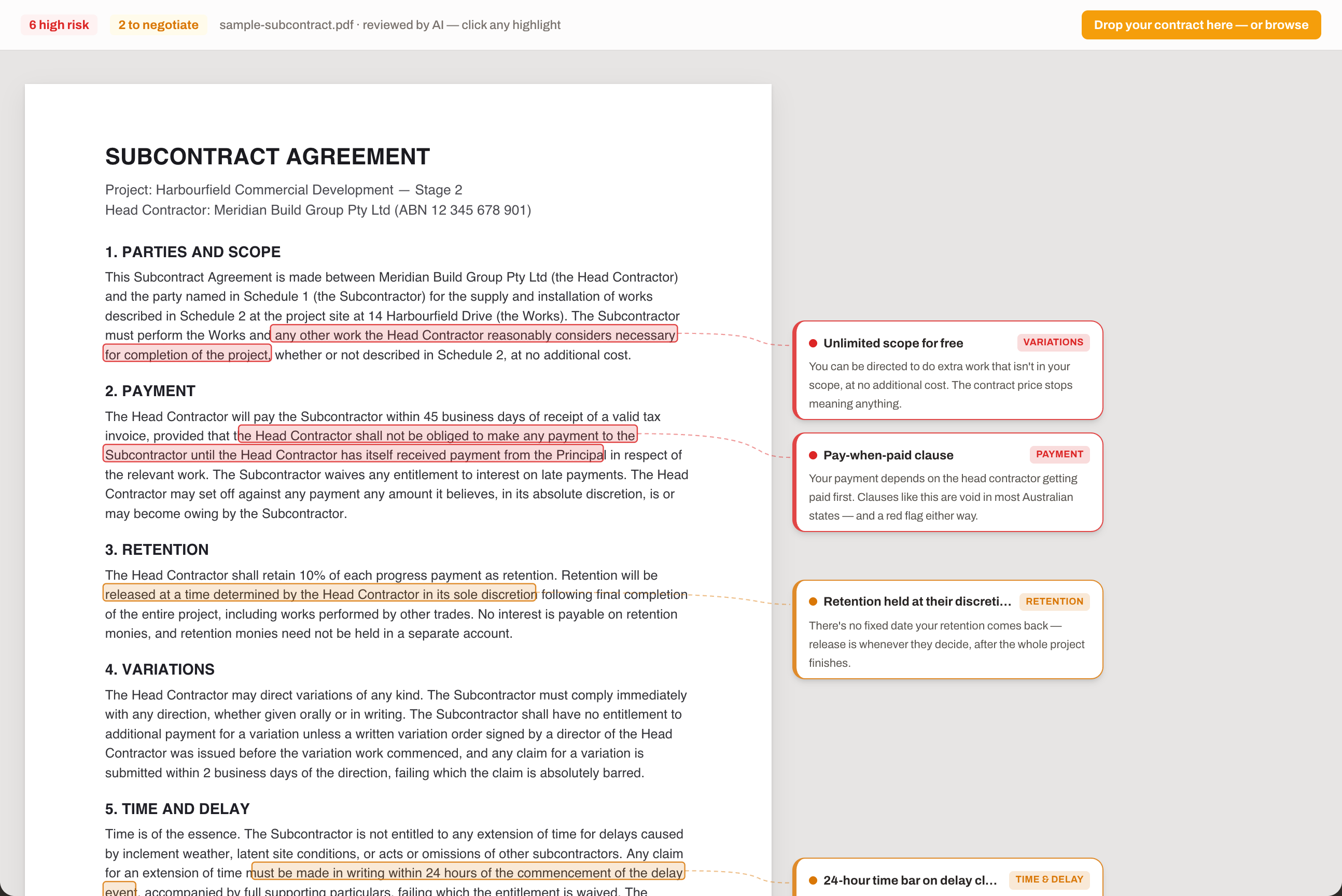
A reviewed construction subcontract in ContractorCounter Review: risky clauses highlighted on the page with margin callouts for pay-when-paid, uncapped liquidated damages, and retention terms
The AI reads your contract before you pay — see a fully reviewed sample free
  • 35-day owner clock, 7-day cascade, 1.5%/mo
  • Suspension right after notice (§28.009)
  • Pay-if-paid enforceable — flagged before you sign
  • Monthly lien notices or the lien dies

The payment clocks

Private work: owner pays within 35 days of the invoice; each party down the chain pays within 7 days of receiving payment; late amounts earn 1.5% per month. Chapter 28 also gives you a right to suspend work after notice (§28.009) — the leverage clause most subs never use. Public work runs under a separate statute (Government Code chapter 2251) with its own clocks. What to check in the draft: payment terms that stretch past these defaults, and invoice preconditions built to restart the clock.

Pay-if-paid is enforceable — the contract is the risk

Texas courts enforce a pay-if-paid clause that clearly and unambiguously makes owner payment a condition precedent of yours, construing any ambiguity against the drafter (Gulf Construction Co. v. Self, 1984). The legislature then boxed it in: a contingent payment clause can't be enforced where the nonpayment results from the contingent payor's own failure to perform, or where the relationship is a sham or enforcement would be unconscionable — and those protections can't be waived (Business & Commerce Code ch. 56, §§56.051–56.054, 56.004). Chapter 56 also gives subs a written-objection route against the clause. None of that helps if you don't know the clause is there: it's the first thing a pre-signature review looks for.

Lien deadlines run out fast

Where the project's original contract (owner to general contractor) was signed on or after 1 January 2022, a subcontractor preserves lien rights by sending notice to the owner and the original contractor by the 15th day of the third month (second month on residential work) after each month you furnished unpaid labor or materials (§53.056) — then filing the lien affidavit by the 15th day of the fourth month (third, residential) after the month the original contractor's work was completed, terminated, or abandoned (§53.052). Miss a monthly notice and that month's lien dies, which is precisely why slow-paying GCs run out the clock. These are notice-discipline deadlines: diarise them the day you sign.

Retainage and waiver forms

Owners must reserve 10% statutory retainage during the work and for 30 days after completion (§53.101), and a claimant's retainage notice now runs on a 30-day rule (§53.057) — older month-based guidance describes pre-2022 law. Lien waivers are only effective if they substantially follow the statutory forms (§§53.281, 53.284), and any clause waiving lien rights in advance is void as against public policy (§53.286). Alongside the rest of your US payment rights, that's the floor — a $19 review shows you where the draft digs under it.

Common questions

Short answers for contractors

Is pay-if-paid enforceable in Texas?

Yes — if the clause clearly and unambiguously makes owner payment a condition precedent to yours, Texas courts enforce it, construing ambiguity against the drafter (Gulf Construction Co. v. Self, 1984). But Business & Commerce Code chapter 56 limits it: the clause can't be enforced where the payor's own contractual failure caused the nonpayment, where the relationship is a sham, or where enforcement would be unconscionable — and those protections cannot be waived (§56.004). The practical defense is catching the clause before you sign.

How long can a contractor take to pay a subcontractor in Texas?

On private work under Property Code chapter 28, the owner pays within 35 days of an invoice and each tier below pays within 7 days of receiving payment, with 1.5% per month interest on late amounts and a right to suspend work after notice (§28.009). Public work follows Government Code chapter 2251 instead. Watch the contract itself, though — an enforceable pay-if-paid condition means the cascade may never start if the owner doesn't pay.

When must a Texas subcontractor send lien notices?

Where the project's original contract was signed on or after 1 January 2022: notice to the owner and original contractor by the 15th day of the third month (second month for residential) following each month you furnished unpaid work (§53.056), and the lien affidavit by the 15th day of the fourth month (third, residential) after the month the original contractor's work was completed, terminated, or abandoned (§53.052). Each unnoticed month falls out of the lien — treat the 15th as a standing monthly deadline on every unpaid job.

How much does an AI construction contract review cost?

ContractorCounter Review costs a flat US$19 per contract, whatever the page count — no subscription, no account, no demo call. The AI reads the contract and shows you what it found (how many issues, how severe, on which pages) before you pay anything; the $19 unlocks the full marked-up review with every clause highlighted and a plain-English concern and negotiation ask for each.

Is my contract kept private?

The contract PDF never leaves your browser — only its extracted text is processed to produce the review, and it is not used to train AI models. Findings are stored temporarily to deliver your purchase (7 days unpurchased, 30 days after unlock) and then deleted automatically.

Is this legal advice?

No. ContractorCounter Review is an AI-powered first-pass review that flags risky, one-sided, and ambiguous clauses so you know exactly what to question. It is not a law firm and its output is not legal advice — for contracts worth serious money, take the marked-up review to a construction lawyer and spend their billable hours on judgment instead of reading.

Get your first takeoff done in minutes

Open a plan set, mark it up, and take quantities off the sheet — in your browser, on any device, with nothing to install.

Start free trial

14-day free trial · No credit card required