California payment rights

Pay-If-Paid Is Void in California — Here's What Isn't

Pay-if-paid clauses are void in California: the Supreme Court held in Wm. R. Clarke Corp. v. Safeco (1997) that conditioning a subcontractor's payment on the owner paying first impermissibly waives lien rights. But the clause still shows up in subcontracts — and the real California traps lie elsewhere: payment windows the statute lets contracts move, waiver forms that only count in statutory form, and lien deadlines that run shorter for subs than for anyone else.

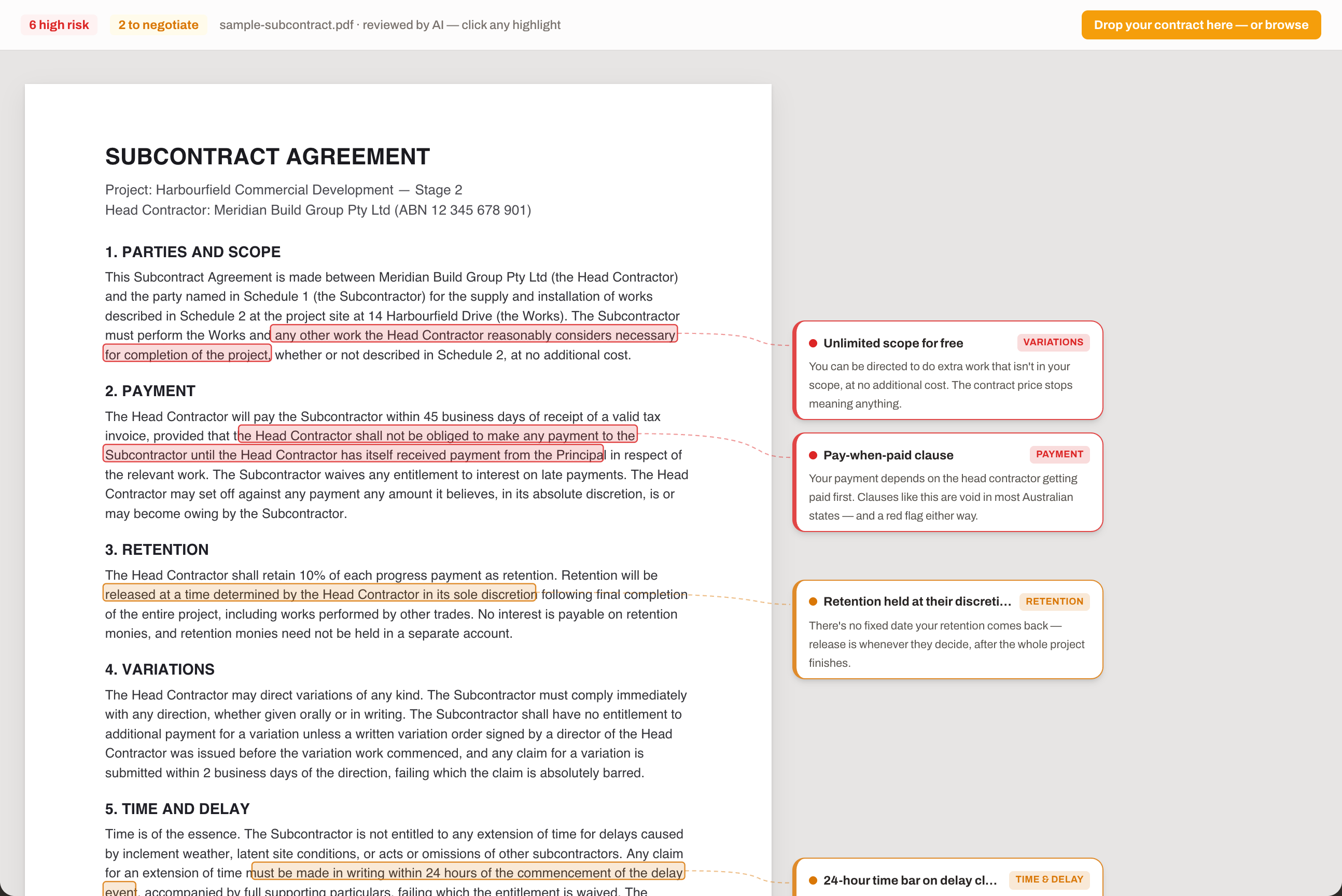
A reviewed construction subcontract in ContractorCounter Review: risky clauses highlighted on the page with margin callouts for pay-when-paid, uncapped liquidated damages, and retention terms
The AI reads your contract before you pay — see a fully reviewed sample free
  • Pay-if-paid void since Clarke v. Safeco
  • 7-day sub payment default + 2%/mo penalty
  • Only 4 statutory lien waiver forms are valid
  • Movable payment dates flagged for $19

Pay-if-paid: void, but still in the draft

Clarke v. Safeco killed the clause in California, while most other US states still enforce clearly drafted versions — which is why national contract templates keep it in. Leaving it unchallenged invites payment games even though it's unenforceable, and ambiguous pay-when-paid wording is generally read as a timing clause, not a transfer of the owner-insolvency risk. Strike it anyway, and check what surrounds it.

Prompt payment: strong penalties, movable dates

California's private-work defaults: an owner pays a progress payment within 30 days after a notice demanding payment (Civil Code §8800), and a contractor passes each sub its share of a progress payment within 7 days of receipt (Bus. & Prof. Code §7108.5) — wrongful withholding costs 2% per month plus prevailing-party fees, and late payment to subs is grounds for CSLB discipline. The catch: both statutes yield to different terms agreed in writing. The dates are defaults, not guarantees — so the thing to check before signing is whether your subcontract quietly stretches them. A good-faith dispute only ever justifies withholding up to 150% of the disputed amount.

Lien waivers: only four forms count

A contract term waiving your lien, stop-notice, or bond rights in advance is void (Civil Code §8122), and a waiver and release is null and void unless it substantially follows one of the four statutory forms — conditional and unconditional, progress and final (§§8132–8138). If a payment package asks you to sign anything else, that's a flag. And never hand over an unconditional release for money you haven't received: conditional forms exist for exactly that moment.

Retention and the deadlines that kill claims

Private retention: the owner releases within 45 days of completion (§8812), your share flows down within 10 days of receipt (§8814), and wrongfully withheld retention accrues 2% per month (§8818) — see retention clauses for the games played around release. On public works signed since 2012, retention is capped at 5% per payment (PCC §7201). The deadlines: serve your preliminary notice within 20 days of first furnishing (§8204); record a lien within 90 days of completion — or just 30 days after a notice of completion is recorded, not the 60 days direct contractors get (§8414); then sue within 90 days or the lien expires (§8460). A $19 contract review flags the clauses; the calendar is yours to run.

Common questions

Short answers for contractors

Is a pay-if-paid clause enforceable in California?

No. The California Supreme Court held in Wm. R. Clarke Corp. v. Safeco Insurance (1997) that pay-if-paid clauses are void because they impermissibly waive the subcontractor's lien rights. The clause still appears in subcontracts — especially national templates drafted for states that enforce it — so strike it rather than rely on unenforceability, and treat its presence as a signal to check the rest of the payment terms.

How quickly must a subcontractor be paid in California?

For progress payments on private work, the default is 7 days after the contractor receives payment (Business & Professions Code §7108.5), with a 2% per month penalty, prevailing-party attorney fees, and exposure to CSLB discipline for violations. But the statute applies 'unless otherwise agreed to in writing' — your subcontract can lawfully set longer terms, which is exactly why the payment clause deserves a careful read before you sign. Retention runs on its own clock: your share within 10 days of the contractor receiving it (Civil Code §8814).

What lien waiver forms are valid in California?

Only the four statutory forms: conditional and unconditional waivers for progress payments (Civil Code §§8132, 8134) and conditional and unconditional final waivers (§§8136, 8138). A waiver that doesn't substantially follow the statutory text is null, void, and unenforceable — and any contract clause waiving lien rights in advance is void under §8122. Sign conditional forms until the money has actually cleared.

How much does an AI construction contract review cost?

ContractorCounter Review costs a flat US$19 per contract, whatever the page count — no subscription, no account, no demo call. The AI reads the contract and shows you what it found (how many issues, how severe, on which pages) before you pay anything; the $19 unlocks the full marked-up review with every clause highlighted and a plain-English concern and negotiation ask for each.

Is my contract kept private?

The contract PDF never leaves your browser — only its extracted text is processed to produce the review, and it is not used to train AI models. Findings are stored temporarily to deliver your purchase (7 days unpurchased, 30 days after unlock) and then deleted automatically.

Is this legal advice?

No. ContractorCounter Review is an AI-powered first-pass review that flags risky, one-sided, and ambiguous clauses so you know exactly what to question. It is not a law firm and its output is not legal advice — for contracts worth serious money, take the marked-up review to a construction lawyer and spend their billable hours on judgment instead of reading.

Get your first takeoff done in minutes

Open a plan set, mark it up, and take quantities off the sheet — in your browser, on any device, with nothing to install.

Start free trial

14-day free trial · No credit card required